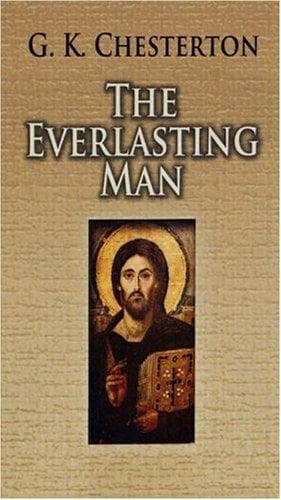
The Everlasting ManChesterton, G. K. (Gilbert Keith)
Religion
The Everlasting Man
Chesterton, G. K. (Gilbert Keith)
Catholic Church -- Apologetic works; Christianity and other religions; Religion
tradition to make a convention. Pastoral poetry is certainly often a
convention, especially in a social decline. It was in a social decline
that Watteau shepherds and shepherdesses lounged about the gardens of
Versailles. It was also in a social decline that shepherds and
shepherdesses continued to pipe and dance through the most faded
imitations of Virgil. But that is no reason for dismissing the dying
paganism without ever understanding its life. It is no reason for
forgetting that the very word Pagan is the same as the word Peasant. We
may say that this art is only artificiality; but it is not a love of the
artificial. On the contrary, it is in its very nature only the failure
of nature-worship, or the love of the natural.
For the shepherds were dying because their gods were dying. Paganism
lived upon poetry; that poetry already considered under the name of
mythology. But everywhere, and especially in Italy, it had been a
mythology and a poetry rooted in the countryside; and that rustic
religion had been largely responsible for the rustic happiness. Only as
the whole society grew in age and experience, there began to appear that
weakness in all mythology already noted in the chapter under that name.
This religion was not quite a religion. In other words, this religion
was not quite a reality. It was the young world’s riot with images and
ideas like a young man’s riot with wine or love-making; it was not so
much immoral as irresponsible; it had no foresight of the final test of
time. Because it was creative to any extent it was credulous to any
extent. It belonged to the artistic side of man, yet even considered
artistically it had long become overloaded and entangled. The family
trees sprung from the seed of Jupiter were a jungle rather than a
forest; the claims of the gods and demigods seemed like things to be
settled rather by a lawyer or a professional herald than by a poet. But
it is needless to say that it was not only in the artistic sense that
these things had grown more anarchic. There had appeared in more and
more flagrant fashion that flower of evil that is really implicit in the
very seed of nature-worship, however natural it may seem. I have said
that I do not believe that natural worship necessarily begins with this
particular passion; I am not of the De Rougemont school of scientific
folklore. I do not believe that mythology must begin in eroticism. But I
do believe that mythology must end in it. I am quite certain that
mythology did end in it. Moreover, not only did the poetry grow more
immoral, but the immorality grew more indefensible. Greek vices,
oriental vices, hints of the old horrors of the Semitic demons, began to
fill the fancies of decaying Rome, swarming like flies on a dung-heap.
The psychology of it is really human enough, to any one who will try
that experiment of seeing history from the inside. There comes an hour
in the afternoon when the child is tired of ‘pretending’; when he is
Public-domain text, read in full here on John Shaqi.
Reviews
Reviews
No reviews yet
Be the first to share your thoughts on this work.
Elsewhere in the archive
Join the Discussion
Join the discussion
Sign in to leave a comment or review.
Sign InorCreate an account