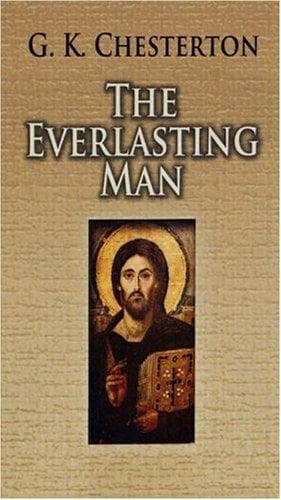
The Everlasting ManChesterton, G. K. (Gilbert Keith)
Religion
The Everlasting Man
Chesterton, G. K. (Gilbert Keith)
Catholic Church -- Apologetic works; Christianity and other religions; Religion
But this notion of something smooth and slow, like the ascent of a
slope, is a great part of the illusion. It is an illogicality as well as
an illusion; for slowness has really nothing to do with the question. An
event is not any more intrinsically intelligible or unintelligible
because of the pace at which it moves. For a man who does not believe in
a miracle, a slow miracle would be just as incredible as a swift one.
The Greek witch may have turned sailors to swine with a stroke of the
wand. But to see a naval gentleman of our acquaintance looking a little
more like a pig every day, till he ended with four trotters and a curly
tail, would not be any more soothing. It might be rather more creepy and
uncanny. The medieval wizard may have flown through the air from the top
of a tower; but to see an old gentleman walking through the air, in a
leisurely and lounging manner, would still seem to call for some
explanation. Yet there runs through all the rationalistic treatment of
history this curious and confused idea that difficulty is avoided, or
even mystery eliminated, by dwelling on mere delay or on something
dilatory in the processes of things. There will be something to be said
upon particular examples elsewhere; the question here is the false
atmosphere of facility and ease given by the mere suggestion of going
slow; the sort of comfort that might be given to a nervous old woman
travelling for the first time in a motor-car.
Mr. H. G. Wells has confessed to being a prophet; and in this matter he
was a prophet at his own expense. It is curious that his first
fairy-tale was a complete answer to his last book of history. The Time
Machine destroyed in advance all comfortable conclusions founded on the
mere relativity of time. In that sublime nightmare the hero saw trees
shoot up like green rockets, and vegetation spread visibly like a green
conflagration, or the sun shoot across the sky from east to west with
the swiftness of a meteor. Yet in his sense these things were quite as
natural when they went swiftly; and in our sense they are quite as
supernatural when they go slowly. The ultimate question is why they go
at all; and anybody who really understands that question will know that
it always has been and always will be a religious question; or at any
rate a philosophical or metaphysical question. And most certainly he
will not think the question answered by some substitution of gradual for
abrupt change; or, in other words, by a merely relative question of the
same story being spun out or rattled rapidly through, as can be done
with any story at a cinema by turning a handle.
Public-domain text, read in full here on John Shaqi.
Reviews
Reviews
No reviews yet
Be the first to share your thoughts on this work.
Join the Discussion
Join the discussion
Sign in to leave a comment or review.
Sign InorCreate an account