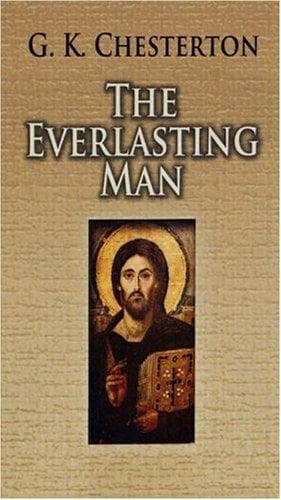
The Everlasting ManChesterton, G. K. (Gilbert Keith)
Religion
The Everlasting Man
Chesterton, G. K. (Gilbert Keith)
Catholic Church -- Apologetic works; Christianity and other religions; Religion
Many moderns have insisted on the smallness of that Mediterranean world;
and the wider horizons that might have awaited it with the discovery of
the other continents. But this is an illusion; one of the many illusions
of materialism. The limits that paganism had reached in Europe were the
limits of human existence; at its best it had only reached the same
limits anywhere else. The Roman stoics did not need any Chinamen to
teach them stoicism. The Pythagoreans did not need any Hindus to teach
them about recurrence or the simple life or the beauty of being a
vegetarian. In so far as they could get these things from the East, they
had already got rather too much of them from the East. The Syncretists
were as convinced as Theosophists that all religions are really the
same. And how else could they have extended philosophy merely by
extending geography? It can hardly be proposed that they should learn a
purer religion from the Aztecs or sit at the feet of the Incas of Peru.
All the rest of the world was a welter of barbarism. It is essential to
recognise that the Roman Empire was recognised as the highest
achievement of the human race; and also as the broadest. A dreadful
secret seemed to be written as in obscure hieroglyphics across those
mighty works of marble and stone, those colossal amphitheatres and
aqueducts. Man could do no more.
For it was not the message blazed on the Babylonian wall, that one king
was found wanting or his one kingdom given to a stranger. It was no such
good news as the news of invasion and conquest. There was nothing left
that could conquer Rome; but there was also nothing left that could
improve it. It was the strongest thing that was growing weak. It was the
best thing that was going to the bad. It is necessary to insist again
and again that many civilisations had met in one civilisation of the
Mediterranean sea; that it was already universal with a stale and
sterile universality. The peoples had pooled their resources and still
there was not enough. The empires had gone into partnership and they
were still bankrupt. No philosopher who was really philosophical could
think anything except that, in that central sea, the wave of the world
had risen to its highest, seeming to touch the stars. But the wave was
already stooping; for it was only the wave of the world.
Public-domain text, read in full here on John Shaqi.
Reviews
Reviews
No reviews yet
Be the first to share your thoughts on this work.
Elsewhere in the archive
Join the Discussion
Join the discussion
Sign in to leave a comment or review.
Sign InorCreate an account