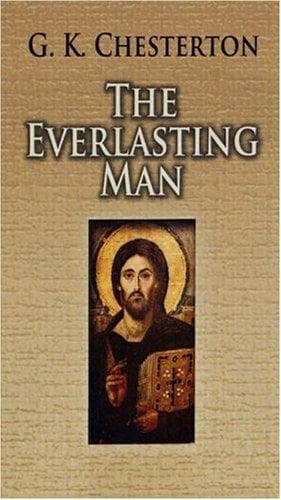
The Everlasting ManChesterton, G. K. (Gilbert Keith)
Religion
The Everlasting Man
Chesterton, G. K. (Gilbert Keith)
Catholic Church -- Apologetic works; Christianity and other religions; Religion
That mythology and that philosophy into which paganism has already been
analysed had thus both of them been drained most literally to the dregs.
If with the multiplication of magic the third department, which we have
called the demons, was even increasingly active, it was never anything
but destructive. There remains only the fourth element, or rather the
first; that which had been in a sense forgotten because it was the
first. I mean the primary and overpowering yet impalpable impression
that the universe after all has one origin and one aim; and because it
has an aim must have an author. What became of this great truth in the
background of men’s minds, at this time, it is perhaps more difficult to
determine. Some of the Stoics undoubtedly saw it more and more clearly
as the clouds of mythology cleared and thinned away; and great men among
them did much even to the last to lay the foundations of a concept of
the moral unity of the world. The Jews still held their secret certainty
of it jealously behind high fences of exclusiveness; yet it is intensely
characteristic of the society and the situation that some fashionable
figures, especially fashionable ladies, actually embraced Judaism. But
in the case of many others I fancy there entered at this point a new
negation. Atheism became really possible in that abnormal time; for
atheism is abnormality. It is not merely the denial of a dogma. It is
the reversal of a subconscious assumption in the soul; the sense that
there is a meaning and a direction in the world it sees. Lucretius, the
first evolutionist who endeavoured to substitute Evolution for God, had
already dangled before men’s eyes his dance of glittering atoms, by
which he conceived cosmos as created by chaos. But it was not his strong
poetry or his sad philosophy, as I fancy, that made it possible for men
to entertain such a vision. It was something in the sense of impotence
and despair with which men shook their fists vainly at the stars, as
they saw all the best work of humanity sinking slowly and helplessly
into a swamp. They could easily believe that even creation itself was
not a creation but a perpetual fall, when they saw that the weightiest
and worthiest of all human creations was falling by its own weight. They
could fancy that all the stars were falling stars; and that the very
pillars of their own solemn porticos were bowed under a sort of gradual
Deluge. To men in that mood there was a reason for atheism that is in
some sense reasonable. Mythology might fade and philosophy might
stiffen; but if behind these things there was a reality, surely that
reality might have sustained things as they sank. There was no God; if
there had been a God, surely this was the very moment when He would have
moved and saved the world.
Public-domain text, read in full here on John Shaqi.
Reviews
Reviews
No reviews yet
Be the first to share your thoughts on this work.
Elsewhere in the archive
Join the Discussion
Join the discussion
Sign in to leave a comment or review.
Sign InorCreate an account