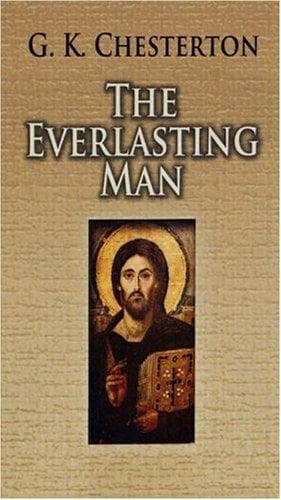
The Everlasting ManChesterton, G. K. (Gilbert Keith)
Religion
The Everlasting Man
Chesterton, G. K. (Gilbert Keith)
Catholic Church -- Apologetic works; Christianity and other religions; Religion
The life of the great civilisation went on with dreary industry and even
with dreary festivity. It was the end of the world, and the worst of it
was that it need never end. A convenient compromise had been made
between all the multitudinous myths and religions of the Empire; that
each group should worship freely and merely give a sort of official
flourish of thanks to the tolerant Emperor, by tossing a little incense
to him under his official title of Divus. Naturally there was no
difficulty about that; or rather it was a long time before the world
realised that there ever had been even a trivial difficulty anywhere.
The members of some eastern sect or secret society or other seemed to
have made a scene somewhere; nobody could imagine why. The incident
occurred once or twice again and began to arouse irritation out of
proportion to its insignificance. It was not exactly what these
provincials said; though of course it sounded queer enough. They seemed
to be saying that God was dead and that they themselves had seen him
die. This might be one of the many manias produced by the despair of the
age; only they did not seem particularly despairing. They seem quite
unnaturally joyful about it, and gave the reason that the death of God
had allowed them to eat him and drink his blood. According to other
accounts God was not exactly dead after all; there trailed through the
bewildered imagination some sort of fantastic procession of the funeral
of God, at which the sun turned black, but which ended with the dead
omnipotence breaking out of the tomb and rising again like the sun. But
it was not the strange story to which anybody paid any particular
attention; people in that world had seen queer religions enough to fill
a madhouse. It was something in the tone of the madmen and their type
of formation. They were a scratch company of barbarians and slaves and
poor and unimportant people; but their formation was military; they
moved together and were very absolute about who and what was really a
part of their little system; and about what they said, however mildly,
there was a ring like iron. Men used to many mythologies and moralities
could make no analysis of the mystery, except the curious conjecture
that they meant what they said. All attempts to make them see reason in
the perfectly simple matter of the Emperor’s statue seemed to be spoken
to deaf men. It was as if a new meteoric metal had fallen on the earth;
it was a difference of substance to the touch. Those who touched their
foundation fancied they had struck a rock.
Public-domain text, read in full here on John Shaqi.
Reviews
Reviews
No reviews yet
Be the first to share your thoughts on this work.
Elsewhere in the archive
Join the Discussion
Join the discussion
Sign in to leave a comment or review.
Sign InorCreate an account