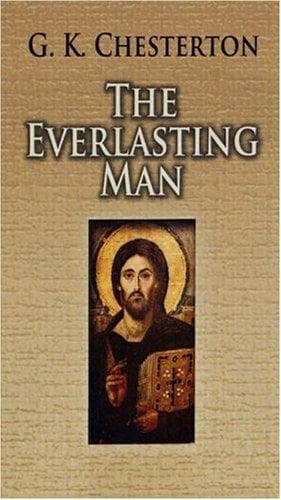
The Everlasting ManChesterton, G. K. (Gilbert Keith)
Religion
The Everlasting Man
Chesterton, G. K. (Gilbert Keith)
Catholic Church -- Apologetic works; Christianity and other religions; Religion
A mass of legend and literature, which increases and will never end, has
repeated and rung the changes on that single paradox; that the hands
that had made the sun and stars were too small to reach the huge heads
of the cattle. Upon this paradox, we might almost say upon this jest,
all the literature of our faith is founded. It is at least like a jest
in this, that it is something which the scientific critic cannot see.
He laboriously explains the difficulty which we have always defiantly
and almost derisively exaggerated; and mildly condemns as improbable
something that we have almost madly exalted as incredible; as something
that would be much too good to be true, except that it is true. When
that contrast between the cosmic creation and the little local infancy
has been repeated, reiterated, underlined, emphasised, exulted in, sung,
shouted, roared, not to say howled, in a hundred thousand hymns, carols,
rhymes, rituals, pictures, poems, and popular sermons, it may be
suggested that we hardly need a higher critic to draw our attention to
something a little odd about it; especially one of the sort that seems
to take a long time to see a joke, even his own joke. But about this
contrast and combination of ideas one thing may be said here, because it
is relevant to the whole thesis of this book. The sort of modern critic
of whom I speak is generally much impressed with the importance of
education in life and the importance of psychology in education. That
sort of man is never tired of telling us that first impressions fix
character by the law of causation; and he will become quite nervous if a
child’s visual sense is poisoned by the wrong colours on a golliwog or
his nervous system prematurely shaken by a cacophonous rattle. Yet he
will think us very narrow-minded if we say that this is exactly why
there really is a difference between being brought up as a Christian and
being brought up as a Jew or a Moslem or an atheist. The difference is
that every Catholic child has learned from pictures, and even every
Protestant child from stories, this incredible combination of contrasted
ideas as one of the very first impressions on his mind. It is not merely
a theological difference. It is a psychological difference which can
outlast any theologies. It really is, as that sort of scientist loves to
say about anything, incurable. Any agnostic or atheist whose childhood
has known a real Christmas has ever afterwards, whether he likes it or
not, an association in his mind between two ideas that most of mankind
must regard as remote from each other; the idea of a baby and the idea
of unknown strength that sustains the stars. His instincts and
imagination can still connect them, when his reason can no longer see
the need of the connection; for him there will always be some savour of
religion about the mere picture of a mother and a baby; some hint of
mercy and softening about the mere mention of the dreadful name of God.
Public-domain text, read in full here on John Shaqi.
Reviews
Reviews
No reviews yet
Be the first to share your thoughts on this work.
Elsewhere in the archive
Join the Discussion
Join the discussion
Sign in to leave a comment or review.
Sign InorCreate an account