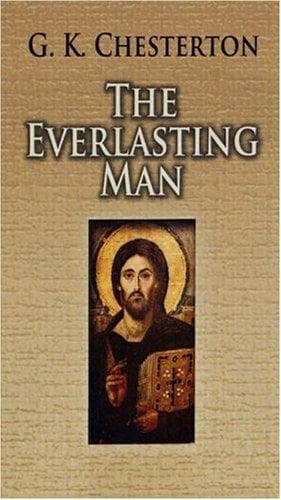
The Everlasting ManChesterton, G. K. (Gilbert Keith)
Religion
The Everlasting Man
Chesterton, G. K. (Gilbert Keith)
Catholic Church -- Apologetic works; Christianity and other religions; Religion
But the two ideas are not naturally or necessarily combined. They would
not be necessarily combined for an ancient Greek or a Chinaman, even for
Aristotle or Confucius. It is no more inevitable to connect God with an
infant than to connect gravitation with a kitten. It has been created in
our minds by Christmas because we are Christians; because we are
psychological Christians even when we are not theological ones. In other
words, this combination of ideas has emphatically, in the much disputed
phrase, altered human nature. There is really a difference between the
man who knows it and the man who does not. It may not be a difference of
moral worth, for the Moslem or the Jew might be worthier according to
his lights; but it is a plain fact about the crossing of two particular
lights, the conjunction of two stars in our particular horoscope.
Omnipotence and impotence, or divinity and infancy, do definitely make a
sort of epigram which a million repetitions cannot turn into a
platitude. It is not unreasonable to call it unique. Bethlehem is
emphatically a place where extremes meet.
Here begins, it is needless to say, another mighty influence for the
humanisation of Christendom. If the world wanted what is called a
non-controversial aspect of Christianity, it would probably select
Christmas. Yet it is obviously bound up with what is supposed to be a
controversial aspect (I could never at any stage of my opinions imagine
why); the respect paid to the Blessed Virgin. When I was a boy a more
Puritan generation objected to a statue upon a parish church
representing the Virgin and Child. After much controversy, they
compromised by taking away the Child. One would think that this was even
more corrupted with Mariolatry, unless the mother was counted less
dangerous when deprived of a sort of weapon. But the practical
difficulty is also a parable. You cannot chip away the statue of a
mother from all round that of a new-born child. You cannot suspend the
new-born child in mid-air; indeed you cannot really have a statue of a
new-born child at all. Similarly, you cannot suspend the idea of a
new-born child in the void or think of him without thinking of his
mother. You cannot visit the child without visiting the mother; you
cannot in common human life approach the child except through the
mother. If we are to think of Christ in this aspect at all, the other
idea follows as it is followed in history. We must either leave Christ
out of Christmas, or Christmas out of Christ, or we must admit, if only
as we admit it in an old picture, that those holy heads are too near
together for the haloes not to mingle and cross.
Public-domain text, read in full here on John Shaqi.
Reviews
Reviews
No reviews yet
Be the first to share your thoughts on this work.
Elsewhere in the archive
Join the Discussion
Join the discussion
Sign in to leave a comment or review.
Sign InorCreate an account