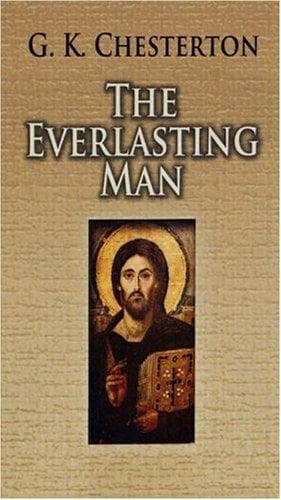
The Everlasting ManChesterton, G. K. (Gilbert Keith)
Religion
The Everlasting Man
Chesterton, G. K. (Gilbert Keith)
Catholic Church -- Apologetic works; Christianity and other religions; Religion
And the reason for this also refers to the very nature of that new
world. It was in a sense the difficulty of a new dimension. Christ was
not only born on the level of the world, but even lower than the world.
The first act of the divine drama was enacted, not only on no stage set
up above the sightseer, but on a dark and curtained stage sunken out of
sight; and that is an idea very difficult to express in most modes of
artistic expression. It is the idea of simultaneous happenings on
different levels of life. Something like it might have been attempted in
the more archaic and decorative medieval art. But the more the artists
learned of realism and perspective, the less they could depict at once
the angels in the heavens and the shepherds on the hills, and the glory
in the darkness that was under the hills. Perhaps it could have been
best conveyed by the characteristic expedient of some of the medieval
guilds, when they wheeled about the streets a theatre with three stages
one above the other, with heaven above the earth and hell under the
earth. But in the riddle of Bethlehem it was heaven that was under the
earth.
There is in that alone the touch of a revolution, as of the world turned
upside down. It would be vain to attempt to say anything adequate, or
anything new, about the change which this conception of a deity born
like an outcast or even an outlaw had upon the whole conception of law
and its duties to the poor and outcast. It is profoundly true to say
that after that moment there could be no slaves. There could be and were
people bearing that legal title until the Church was strong enough to
weed them out, but there could be no more of the pagan repose in the
mere advantage to the state of keeping it a servile state. Individuals
became important, in a sense in which no instruments can be important.
A man could not be a means to an end, at any rate to any other man’s
end. All this popular and fraternal element in the story has been
rightly attached by tradition to the episode of the Shepherds; the hinds
who found themselves talking face to face with the princes of heaven.
But there is another aspect of the popular element as represented by the
shepherds which has not perhaps been so fully developed; and which is
more directly relevant here.
Public-domain text, read in full here on John Shaqi.
Reviews
Reviews
No reviews yet
Be the first to share your thoughts on this work.
Elsewhere in the archive
Join the Discussion
Join the discussion
Sign in to leave a comment or review.
Sign InorCreate an account