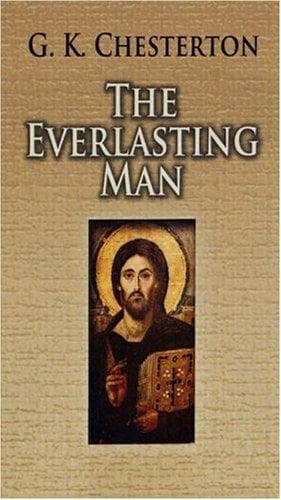
The Everlasting ManChesterton, G. K. (Gilbert Keith)
Religion
The Everlasting Man
Chesterton, G. K. (Gilbert Keith)
Catholic Church -- Apologetic works; Christianity and other religions; Religion
It might be suggested, in a somewhat violent image, that nothing had
happened in that fold or crack in the great grey hills except that the
whole universe had been turned inside out. I mean that all the eyes of
wonder and worship which had been turned outwards to the largest thing
were now turned inward to the smallest. The very image will suggest all
that multitudinous marvel of converging eyes that makes so much of the
coloured Catholic imagery like a peacock’s tail. But it is true in a
sense that God who had been only a circumference was seen as a centre;
and a centre is infinitely small. It is true that the spiritual spiral
henceforward works inwards instead of outwards, and in that sense is
centripetal and not centrifugal. The faith becomes, in more ways than
one, a religion of little things. But its traditions in art and
literature and popular fable have quite sufficiently attested, as has
been said, this particular paradox of the divine being in the cradle.
Perhaps they have not so clearly emphasised the significance of the
divine being in the cave. Curiously enough, indeed, tradition has not
very clearly emphasised the cave. It is a familiar fact that the
Bethlehem scene has been represented in every possible setting of time
and country, of landscape and architecture; and it is a wholly happy and
admirable fact that men have conceived it as quite different according
to their different individual traditions and tastes. But while all have
realised that it was a stable, not so many have realised that it was a
cave. Some critics have even been so silly as to suppose that there was
some contradiction between the stable and the cave; in which case they
cannot know much about caves or stables in Palestine. As they see
differences that are not there, it is needless to add that they do not
see differences that are there. When a well-known critic says, for
instance, that Christ being born in a rocky cavern is like Mithras
having sprung alive out of a rock, it sounds like a parody upon
comparative religion. There is such a thing as the point of a story,
even if it is a story in the sense of a lie. And the notion of a hero
appearing, like Pallas from the brain of Zeus, mature and without a
mother, is obviously the very opposite of the idea of a god being born
like an ordinary baby and entirely dependent on a mother. Whichever
ideal we might prefer, we should surely see that they are contrary
ideals. It is as stupid to connect them because they both contain a
substance called stone as to identify the punishment of the Deluge with
the baptism in the Jordan because they both contain a substance called
water. Whether as a myth or a mystery, Christ was obviously conceived as
born in a hole in the rocks primarily because it marked the position of
one outcast and homeless. Nevertheless it is true, as I have said, that
the cave has not been so commonly or so clearly used as a symbol as the
other realities that surrounded the first Christmas.
Public-domain text, read in full here on John Shaqi.
Reviews
Reviews
No reviews yet
Be the first to share your thoughts on this work.
Elsewhere in the archive
Join the Discussion
Join the discussion
Sign in to leave a comment or review.
Sign InorCreate an account