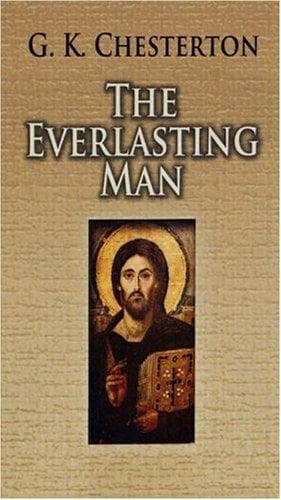
The Everlasting ManChesterton, G. K. (Gilbert Keith)
Religion
The Everlasting Man
Chesterton, G. K. (Gilbert Keith)
Catholic Church -- Apologetic works; Christianity and other religions; Religion
We all know that the popular presentation of this popular story, in so
many miracle plays and carols, has given to the shepherds the costume,
the language, and the landscape of the separate English and European
countrysides. We all know that one shepherd will talk in a Somerset
dialect or another talk of driving his sheep from Conway towards the
Clyde. Most of us know by this time how true is that error, how wise,
how artistic, how intensely Christian and Catholic is that anachronism.
But some who have seen it in these scenes of medieval rusticity have
perhaps not seen it in another sort of poetry, which it is sometimes the
fashion to call artificial rather than artistic. I fear that many modern
critics will see only a faded classicism in the fact that men like
Crashaw and Herrick conceived the shepherds of Bethlehem under the form
of the shepherds of Virgil. Yet they were profoundly right; and in
turning their Bethlehem play into a Latin Eclogue they took up one of
the most important links in human history. Virgil, as we have already
seen, does stand for all that saner heathenism that had overthrown the
insane heathenism of human sacrifice; but the very fact that even the
Virgilian virtues and the sane heathenism were in incurable decay is the
whole problem to which the revelation to the shepherds is the solution.
If the world had ever had the chance to grow weary of being demoniac, it
might have been healed merely by becoming sane. But if it had grown
weary even of being sane, what was to happen except what did happen? Nor
is it false to conceive the Arcadian shepherd of the Eclogues as
rejoicing in what did happen. One of the Eclogues has even been claimed
as a prophecy of what did happen. But it is quite as much in the tone
and incidental diction of the great poet that we feel the potential
sympathy with the great event; and even in their own human phrases the
voices of the Virgilian shepherds might more than once have broken upon
more than the tenderness of Italy.... _Incipe, parve puer, risu
cognoscere matrem._... They might have found in that strange place all
that was best in the last traditions of the Latins; and something better
than a wooden idol standing up for ever for the pillar of the human
family; a Household God. But they and all the other mythologists would
be justified in rejoicing that the event had fulfilled not merely the
mysticism but the materialism of mythology. Mythology had many sins; but
it had not been wrong in being as carnal as the Incarnation. With
something of the ancient voice that was supposed to have rung through
the groves, it could cry again, ‘We have seen, he hath seen us, a
visible god.’ So the ancient shepherds might have danced, and their feet
have been beautiful upon the mountains, rejoicing over the philosophers.
But the philosophers had also heard.
Public-domain text, read in full here on John Shaqi.
Reviews
Reviews
No reviews yet
Be the first to share your thoughts on this work.
Elsewhere in the archive
Join the Discussion
Join the discussion
Sign in to leave a comment or review.
Sign InorCreate an account