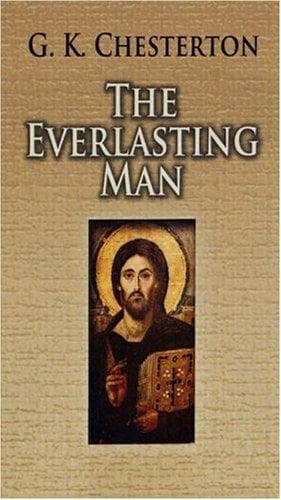
The Everlasting ManChesterton, G. K. (Gilbert Keith)
Religion
The Everlasting Man
Chesterton, G. K. (Gilbert Keith)
Catholic Church -- Apologetic works; Christianity and other religions; Religion
The Theosophists build a pantheon; but it is only a pantheon for
pantheists. They call a Parliament of Religions as a reunion of all the
peoples; but it is only a reunion of all the prigs. Yet exactly such a
pantheon had been set up two thousand years before by the shores of the
Mediterranean; and Christians were invited to set up the image of Jesus
side by side with the image of Jupiter, of Mithras, of Osiris, of Atys,
or of Ammon. It was the refusal of the Christians that was the
turning-point of history. If the Christians had accepted, they and the
whole world would have certainly, in a grotesque but exact metaphor,
gone to pot. They would all have been boiled down to one lukewarm liquid
in that great pot of cosmopolitan corruption in which all the other
myths and mysteries were already melting. It was an awful and an
appalling escape. Nobody understands the nature of the Church, or the
ringing note of the creed descending from antiquity, who does not
realise that the whole world once very nearly died of broadmindedness
and the brotherhood of all religions.
Here it is the important point that the Magi, who stand for mysticism
and philosophy, are truly conceived as seeking something new and even as
finding something unexpected. That tense sense of crisis which still
tingles in the Christmas story, and even in every Christmas celebration,
accentuates the idea of a search and a discovery. The discovery is, in
this case, truly a scientific discovery. For the other mystical figures
in the miracle play, for the angel and the mother, the shepherds and the
soldiers of Herod, there may be aspects both simpler and more
supernatural, more elemental or more emotional. But the Wise Men must be
seeking wisdom; and for them there must be a light also in the
intellect. And this is the light: that the Catholic creed is catholic
and that nothing else is catholic. The philosophy of the Church is
universal. The philosophy of the philosophers was not universal. Had
Plato and Pythagoras and Aristotle stood for an instant in the light
that came out of that little cave, they would have known that their own
light was not universal. It is far from certain, indeed, that they did
not know it already. Philosophy also, like mythology, had very much the
air of a search. It is the realisation of this truth that gives its
traditional majesty and mystery to the figures of the Three Kings; the
discovery that religion is broader than philosophy and that this is the
broadest of religions, contained within this narrow space. The Magicians
were gazing at the strange pentacle with the human triangle reversed;
and they have never come to the end of their calculations about it. For
it is the paradox of that group in the cave, that while our emotions
about it are of childish simplicity, our thoughts about it can branch
with a never-ending complexity. And we can never reach the end even of
our own ideas about the child who was a father and the mother who was a
child.
Public-domain text, read in full here on John Shaqi.
Reviews
Reviews
No reviews yet
Be the first to share your thoughts on this work.
Elsewhere in the archive
Join the Discussion
Join the discussion
Sign in to leave a comment or review.
Sign InorCreate an account