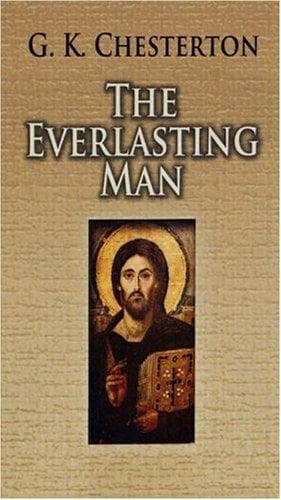
The Everlasting ManChesterton, G. K. (Gilbert Keith)
Religion
The Everlasting Man
Chesterton, G. K. (Gilbert Keith)
Catholic Church -- Apologetic works; Christianity and other religions; Religion
We might well be content to say that mythology had come with the
shepherds and philosophy with the philosophers; and that it only
remained for them to combine in the recognisation of religion. But there
was a third element that must not be ignored and one which that religion
for ever refuses to ignore, in any revel or reconciliation. There was
present in the primary scenes of the drama that Enemy that had rotted
the legends with lust and frozen the theories into atheism, but which
answered the direct challenge with something of that more direct method
which we have seen in the conscious cult of the demons. In the
description of that demon-worship, of the devouring detestation of
innocence shown in the works of its witchcraft and the most inhuman of
its human sacrifice, I have said less of its indirect and secret
penetration of the saner paganism; the soaking of mythological
imagination with sex; the rise of imperial pride into insanity. But both
the indirect and the direct influence make themselves felt in the drama
of Bethlehem. A ruler under the Roman suzerainty, probably equipped and
surrounded with the Roman ornament and order though himself of eastern
blood, seems in that hour to have felt stirring within him the spirit of
strange things. We all know the story of how Herod, alarmed at some
rumour of a mysterious rival, remembered the wild gesture of the
capricious despots of Asia and ordered a massacre of suspects of the new
generation of the populace. Every one knows the story; but not every one
has perhaps noted its place in the story of the strange religions of
men. Not everybody has seen the significance even of its very contrast
with the Corinthian columns and Roman pavement of that conquered and
superficially civilised world. Only, as the purpose in his dark spirit
began to show and shine in the eyes of the Idumean, a seer might perhaps
have seen something like a great grey ghost that looked over his
shoulder; have seen behind him, filling the dome of night and hovering
for the last time over history, that vast and fearful face that was
Moloch of the Carthaginians; awaiting his last tribute from a ruler of
the races of Shem. The demons also, in that first festival of Christmas,
feasted after their own fashion.
Public-domain text, read in full here on John Shaqi.
Reviews
Reviews
No reviews yet
Be the first to share your thoughts on this work.
Elsewhere in the archive
Join the Discussion
Join the discussion
Sign in to leave a comment or review.
Sign InorCreate an account