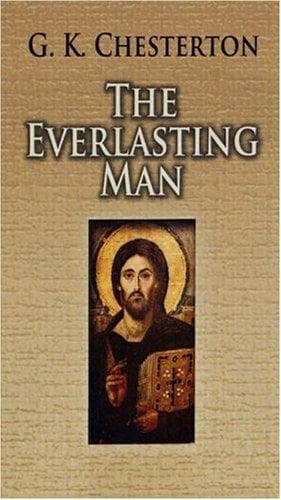
The Everlasting ManChesterton, G. K. (Gilbert Keith)
Religion
The Everlasting Man
Chesterton, G. K. (Gilbert Keith)
Catholic Church -- Apologetic works; Christianity and other religions; Religion
In short, we can say that these ideals are impossible in themselves.
Exactly what we cannot say is that they are impossible for us. They are
rather notably marked by a mysticism which, if it be a sort of madness,
would always have struck the same sort of people as mad. Take, for
instance, the case of marriage and the relations of the sexes. It might
very well have been true that a Galilean teacher taught things natural
to a Galilean environment; but it is not. It might rationally be
expected that a man in the time of Tiberius would have advanced a view
conditioned by the time of Tiberius; but he did not. What he advanced
was something quite different; something very difficult; but something
no more difficult now than it was then. When, for instance, Mahomet made
his polygamous compromise we may reasonably say that it was conditioned
by a polygamous society. When he allowed a man four wives he was really
doing something suited to the circumstances, which might have been less
suited to other circumstances. Nobody will pretend that the four wives
were like the four winds, something seemingly a part of the order of
nature; nobody will say that the figure four was written for ever in
stars upon the sky. But neither will any one say that the figure four is
an inconceivable ideal; that it is beyond the power of the mind of man
to count up to four; or to count the number of his wives and see whether
it amounts to four. It is a practical compromise carrying with it the
character of a particular society. If Mahomet had been born in Acton in
the nineteenth century, we may well doubt whether he would instantly
have filled that suburb with harems of four wives apiece. As he was born
in Arabia in the sixth century, he did in his conjugal arrangements
suggest the conditions of Arabia in the sixth century. But Christ in his
view of marriage does not in the least suggest the conditions of
Palestine in the first century. He does not suggest anything at all,
except the sacramental view of marriage as developed long afterwards by
the Catholic Church. It was quite as difficult for people then as for
people now. It was much more puzzling to people then than to people now.
Jews and Romans and Greeks did not believe, and did not even understand
enough to disbelieve, the mystical idea that the man and the woman had
become one sacramental substance. We may think it an incredible or
impossible ideal; but we cannot think it any more incredible or
impossible than they would have thought it. In other words, whatever
else is true, it is not true that the controversy has been altered by
time. Whatever else is true, it is emphatically not true that the ideas
of Jesus of Nazareth were suitable to his time, but are no longer
suitable to our time. Exactly how suitable they were to his time is
perhaps suggested in the end of his story.
Public-domain text, read in full here on John Shaqi.
Reviews
Reviews
No reviews yet
Be the first to share your thoughts on this work.
Elsewhere in the archive
Join the Discussion
Join the discussion
Sign in to leave a comment or review.
Sign InorCreate an account