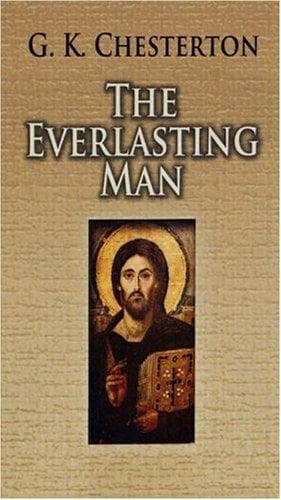
The Everlasting ManChesterton, G. K. (Gilbert Keith)
Religion
The Everlasting Man
Chesterton, G. K. (Gilbert Keith)
Catholic Church -- Apologetic works; Christianity and other religions; Religion
The purpose of these pages is to fix the falsity of certain vague and
vulgar assumptions; and we have here one of the most false. There is a
sort of notion in the air everywhere that all the religions are equal
because all the religious founders were rivals; that they are all
fighting for the same starry crown. It is quite false. The claim to that
crown, or anything like that crown, is really so rare as to be unique.
Mahomet did not make it any more than Micah or Malachi. Confucius did
not make it any more than Plato or Marcus Aurelius. Buddha never said he
was Bramah. Zoroaster no more claimed to be Ormuz than to be Ahriman.
The truth is that, in the common run of cases, it is just as we should
expect it to be, in common sense and certainly in Christian philosophy.
It is exactly the other way. Normally speaking, the greater a man is,
the less likely he is to make the very greatest claim. Outside the
unique case we are considering, the only kind of man who ever does make
that kind of claim is a very small man; a secretive or self-centred
monomaniac. Nobody can imagine Aristotle claiming to be the father of
gods and men, come down from the sky; though we might imagine some
insane Roman Emperor like Caligula claiming it for him, or more probably
for himself. Nobody can imagine Shakespeare talking as if he were
literally divine; though we might imagine some crazy American crank
finding it as a cryptogram in Shakespeare’s works, or preferably in his
own works. It is possible to find here and there human beings who make
this supremely superhuman claim. It is possible to find them in lunatic
asylums; in padded cells; possibly in strait waistcoats. But what is
much more important than their mere materialistic fate in our very
materialistic society, under very crude and clumsy laws about lunacy,
the type we know as tinged with this, or tending towards it, is a
diseased and disproportionate type; narrow yet swollen and morbid to
monstrosity. It is by rather an unlucky metaphor that we talk of a
madman as cracked; for in a sense he is not cracked enough. He is
cramped rather than cracked; there are not enough holes in his head to
ventilate it. This impossibility of letting in daylight on a delusion
does sometimes cover and conceal a delusion of divinity. It can be
found, not among prophets and sages and founders of religions, but only
among a low set of lunatics. But this is exactly where the argument
becomes intensely interesting; because the argument proves too much. For
nobody supposes that Jesus of Nazareth was _that_ sort of person. No
modern critic in his five wits thinks that the preacher of the Sermon on
the Mount was a horrible half-witted imbecile that might be scrawling
stars on the walls of a cell. No atheist or blasphemer believes that the
author of the Parable of the Prodigal Son was a monster with one mad
idea like a cyclops with one eye. Upon any possible historical criticism
he must be put higher in the scale of human beings than that.
Public-domain text, read in full here on John Shaqi.
Reviews
Reviews
No reviews yet
Be the first to share your thoughts on this work.
Elsewhere in the archive
Join the Discussion
Join the discussion
Sign in to leave a comment or review.
Sign InorCreate an account