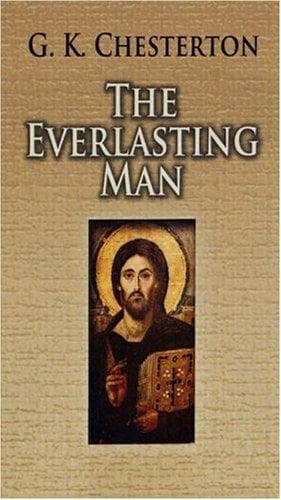
The Everlasting ManChesterton, G. K. (Gilbert Keith)
Religion
The Everlasting Man
Chesterton, G. K. (Gilbert Keith)
Catholic Church -- Apologetic works; Christianity and other religions; Religion
Yet by all
analogy we have really to put him there or else in the highest place of
all.
In fact, those who can really take it (as I here hypothetically take it)
in a quite dry and detached spirit, have here a most curious and
interesting human problem. It is so intensely interesting, considered as
a human problem, that it is in a spirit quite disinterested, so to
speak, that I wish some of them had turned that intricate human problem
into something like an intelligible human portrait. If Christ was simply
a human character, he really was a highly complex and contradictory
human character. For he combined exactly the two things that lie at the
two extremes of human variation. He was exactly what the man with a
delusion never is: he was wise; he was a good judge. What he said was
always unexpected; but it was always unexpectedly magnanimous and often
unexpectedly moderate. Take a thing like the point of the parable of the
tares and the wheat. It has the quality that unites sanity and subtlety.
It has not the simplicity of a madman. It has not even the simplicity of
a fanatic. It might be uttered by a philosopher a hundred years old, at
the end of a century of Utopias. Nothing could be less like this quality
of seeing beyond and all round obvious things, than the condition of the
egomaniac with the one sensitive spot on his brain. I really do not see
how these two characters could be convincingly combined, except in the
astonishing way in which the creed combines them. For until we reach the
full acceptance of the fact as a fact, however marvellous, all mere
approximations to it are actually further and further away from it.
Divinity is great enough to be divine; it is great enough to call itself
divine. But as humanity grows greater, it grows less and less likely to
do so. God is God, as the Moslems say; but a great man knows he is not
God, and the greater he is the better he knows it. That is the paradox;
everything that is merely approaching to that point is merely receding
from it. Socrates, the wisest man, knows that he knows nothing. A
lunatic may think he is omniscience, and a fool may talk as if he were
omniscient. But Christ is in another sense omniscient if he not only
knows, but knows that he knows.
Public-domain text, read in full here on John Shaqi.
Reviews
Reviews
No reviews yet
Be the first to share your thoughts on this work.
Elsewhere in the archive
Join the Discussion
Join the discussion
Sign in to leave a comment or review.
Sign InorCreate an account