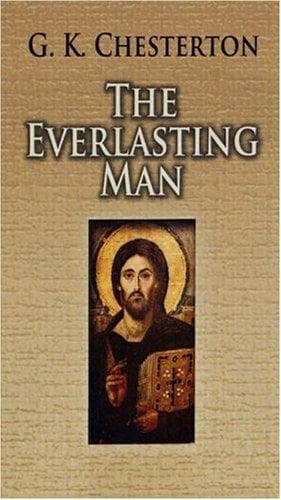
The Everlasting ManChesterton, G. K. (Gilbert Keith)
Religion
The Everlasting Man
Chesterton, G. K. (Gilbert Keith)
Catholic Church -- Apologetic works; Christianity and other religions; Religion
But in another sense the word ‘wandering’ as applied to his life is a
little misleading. As a matter of fact, a great many of the pagan sages
and not a few of the pagan sophists might truly be described as
wandering teachers. In some of them their rambling journeys were not
altogether without a parallel in their rambling remarks. Apollonius of
Tyana, who figured in some fashionable cults as a sort of ideal
philosopher, is represented as rambling as far as the Ganges and
Ethiopia, more or less talking all the time. There was actually a school
of philosophers called the Peripatetics; and most even of the great
philosophers give us a vague impression of having very little to do
except to walk and talk. The great conversations which give us our
glimpses of the great minds of Socrates or Buddha or even Confucius
often seem to be parts of a never-ending picnic; and especially, which
is the important point, to have neither beginning nor end. Socrates did
indeed find the conversation interrupted by the incident of his
execution. But it is the whole point, and the whole particular merit, of
the position of Socrates that death was only an interruption and an
incident. We miss the real moral importance of the great philosopher if
we miss that point; that he stares at the executioner with an innocent
surprise, and almost an innocent annoyance, at finding any one so
unreasonable as to cut short a little conversation for the elucidation
of truth. He is looking for truth and not looking for death. Death is
but a stone in the road which can trip him up. His work in life is to
wander on the roads of the world and talk about truth for ever. Buddha,
on the other hand, did arrest attention by one gesture; it was the
gesture of renunciation, and therefore in a sense of denial. But by one
dramatic negation he passed into a world of negation that was not
dramatic; which he would have been the first to insist was not dramatic.
Here again we miss the particular moral importance of the great mystic
if we do not see the distinction; that it was his whole point that he
had done with drama, which consists of desire and struggle and generally
of defeat and disappointment. He passes into peace and lives to instruct
others how to pass into it. Henceforth his life is that of the ideal
philosopher; certainly a far more really ideal philosopher than
Apollonius of Tyana; but still a philosopher in the sense that it is not
his business to do anything but rather to explain everything; in his
case, we might almost say, mildly and softly to explode everything. For
the messages are basically different. Christ said ‘Seek first the
kingdom, and all these things shall be added unto you.’ Buddha said
‘Seek first the kingdom, and then you will need none of these things.’
Public-domain text, read in full here on John Shaqi.
Reviews
Reviews
No reviews yet
Be the first to share your thoughts on this work.
Elsewhere in the archive
Join the Discussion
Join the discussion
Sign in to leave a comment or review.
Sign InorCreate an account