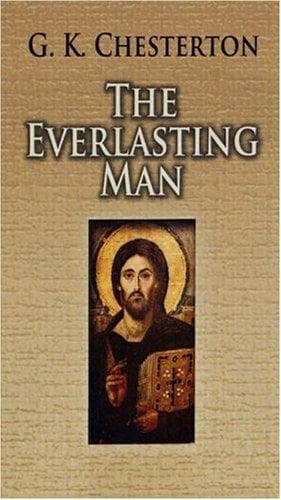
The Everlasting ManChesterton, G. K. (Gilbert Keith)
Religion
The Everlasting Man
Chesterton, G. K. (Gilbert Keith)
Catholic Church -- Apologetic works; Christianity and other religions; Religion
Even on the purely human and sympathetic side, therefore, the Jesus of
the New Testament seems to me to have in a great many ways the note of
something superhuman; that is, of something human and more than human.
But there is another quality running through all his teachings which
seems to me neglected in most modern talk about them as teachings; and
that is the persistent suggestion that he has not really come to teach.
If there is one incident in the record which affects me personally as
grandly and gloriously human, it is the incident of giving wine for the
wedding-feast. That is really human in the sense in which a whole crowd
of prigs, having the appearance of human beings, can hardly be described
as human. It rises superior to all superior persons. It is as human as
Herrick and as democratic as Dickens. But even in that story there is
something else that has that note of things not fully explained; and in
a way here very relevant. I mean the first hesitation, not on any ground
touching the nature of the miracle, but on that of the propriety of
working any miracles at all, at least at that stage; ‘My time is not yet
come.’ What did that mean? At least it certainly meant a general plan or
purpose in the mind, with which certain things did or did not fit in.
And if we leave out that solitary strategic plan, we not only leave out
the point of the story, but the story.
We often hear of Jesus of Nazareth as a wandering teacher; and there is
a vital truth in that view in so far as it emphasises an attitude
towards luxury and convention which most respectable people would still
regard as that of a vagabond. It is expressed in his own great saying
about the holes of the foxes and the nests of the birds, and, like many
of his great sayings, it is felt as less powerful than it is, through
lack of appreciation of that great paradox by which he spoke of his own
humanity as in some way collectively and representatively human; calling
himself simply the Son of Man; that is, in effect, calling himself
simply Man. It is fitting that the New Man or the Second Adam should
repeat in so ringing a voice and with so arresting a gesture the great
fact which came first in the original story: that man differs from the
brutes by everything, even by deficiency; that he is in a sense less
normal and even less native; a stranger upon the earth. It is well to
speak of his wanderings in this sense and in the sense that he shared
the drifting life of the most homeless and hopeless of the poor. It is
assuredly well to remember that he would quite certainly have been moved
on by the police, and almost certainly arrested by the police, for
having no visible means of subsistence. For our law has in it a turn of
humour or touch of fancy which Nero and Herod never happened to think
of; that of actually punishing homeless people for not sleeping at home.
Public-domain text, read in full here on John Shaqi.
Reviews
Reviews
No reviews yet
Be the first to share your thoughts on this work.
Elsewhere in the archive
Join the Discussion
Join the discussion
Sign in to leave a comment or review.
Sign InorCreate an account