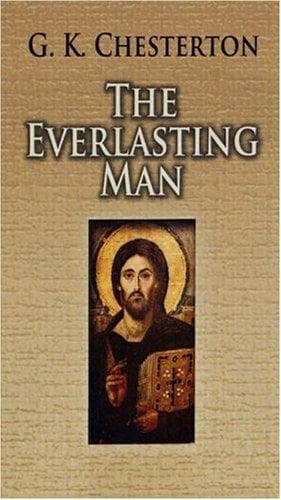
The Everlasting ManChesterton, G. K. (Gilbert Keith)
Religion
The Everlasting Man
Chesterton, G. K. (Gilbert Keith)
Catholic Church -- Apologetic works; Christianity and other religions; Religion
Christ founded the Church with two great figures of speech; in the final
words to the Apostles who received authority to found it. The first was
the phrase about founding it on Peter as on a rock; the second was the
symbol of the keys. About the meaning of the former there is naturally
no doubt in my own case; but it does not directly affect the argument
here save in two more secondary aspects. It is yet another example of a
thing that could only fully expand and explain itself afterwards, and
even long afterwards. And it is yet another example of something the
very reverse of simple and self-evident even in the language, in so far
as it described a man as a rock when he had much more the appearance of
a reed.
But the other image of the keys has an exactitude that has hardly been
exactly noticed. The keys have been conspicuous enough in the art and
heraldry of Christendom; but not every one has noted the peculiar
aptness of the allegory. We have now reached the point in history where
something must be said of the first appearance and activities of the
Church in the Roman Empire; and for that brief description nothing could
be more perfect than that ancient metaphor. The Early Christian was very
precisely a person carrying about a key, or what he said was a key. The
whole Christian movement consisted in claiming to possess that key. It
was not merely a vague forward movement, which might be better
represented by a battering-ram. It was not something that swept along
with it similar and dissimilar things, as does a modern social movement.
As we shall see in a moment, it rather definitely refused to do so. It
definitely asserted that there was a key and that it possessed that key
and that no other key was like it; in that sense it was as narrow as you
please. Only it happened to be the key that could unlock the prison of
the whole world; and let in the white daylight of escape.
The creed was like a key in three respects; which can be most
conveniently summed up under this symbol. First, a key is above all
things a thing with a shape. It is a thing that depends entirely upon
keeping its shape. The Christian creed is above all things the
philosophy of shapes and the enemy of shapelessness. That is where it
differs from all that formless infinity, Manichean or Buddhist, which
makes a sort of pool of night in the dark heart of Asia; the ideal of
uncreating all the creatures. That is where it differs also from the
analogous vagueness of mere evolutionism; the idea of creatures
constantly losing their shape. A man told that his solitary latchkey had
been melted down with a million others into a Buddhistic unity would be
annoyed. But a man told that his key was gradually growing and sprouting
in his pocket, and branching into new wards or complications, would not
be more gratified.
Public-domain text, read in full here on John Shaqi.
Reviews
Reviews
No reviews yet
Be the first to share your thoughts on this work.
Elsewhere in the archive
Join the Discussion
Join the discussion
Sign in to leave a comment or review.
Sign InorCreate an account