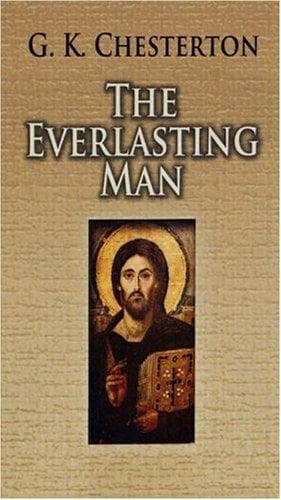
The Everlasting ManChesterton, G. K. (Gilbert Keith)
Religion
The Everlasting Man
Chesterton, G. K. (Gilbert Keith)
Catholic Church -- Apologetic works; Christianity and other religions; Religion
There were solitudes beyond where none shall follow. There were secrets
in the inmost and invisible part of that drama that have no symbol in
speech; or in any severance of a man from men. Nor is it easy for any
words less stark and single-minded than those of the naked narrative
even to hint at the horror of exaltation that lifted itself above the
hill. Endless expositions have not come to the end of it, or even to the
beginning. And if there be any sound that can produce a silence, we may
surely be silent about the end and the extremity; when a cry was driven
out of that darkness in words dreadfully distinct and dreadfully
unintelligible, which man shall never understand in all the eternity
they have purchased for him; and for one annihilating instant an abyss
that is not for our thoughts had opened even in the unity of the
absolute; and God had been forsaken of God.
They took the body down from the cross and one of the few rich men among
the first Christians obtained permission to bury it in a rock tomb in
his garden; the Romans setting a military guard lest there should be
some riot and attempt to recover the body. There was once more a natural
symbolism in these natural proceedings; it was well that the tomb should
be sealed with all the secrecy of ancient eastern sepulture and guarded
by the authority of the Caesars. For in that second cavern the whole of
that great and glorious humanity which we call antiquity was gathered up
and covered over; and in that place it was buried. It was the end of a
very great thing called human history; the history that was merely
human. The mythologies and the philosophies were buried there, the gods
and the heroes and the sages. In the great Roman phrase, they had lived.
But as they could only live, so they could only die; and they were dead.
On the third day the friends of Christ coming at daybreak to the place
found the grave empty and the stone rolled away. In varying ways they
realised the new wonder; but even they hardly realised that the world
had died in the night. What they were looking at was the first day of a
new creation, with a new heaven and a new earth; and in a semblance of
the gardener God walked again in the garden, in the cool not of the
evening but the dawn.
CHAPTER IV
THE WITNESS OF THE HERETICS
Public-domain text, read in full here on John Shaqi.
Reviews
Reviews
No reviews yet
Be the first to share your thoughts on this work.
Elsewhere in the archive
Join the Discussion
Join the discussion
Sign in to leave a comment or review.
Sign InorCreate an account