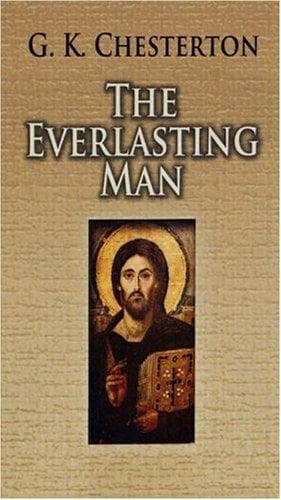
The Everlasting ManChesterton, G. K. (Gilbert Keith)
Religion
The Everlasting Man
Chesterton, G. K. (Gilbert Keith)
Catholic Church -- Apologetic works; Christianity and other religions; Religion
Those who maintain that Christianity was not a Church but a moral
movement of idealists have been forced to push the period of its
perversion or disappearance further and further back. A bishop of Rome
writes claiming authority in the very lifetime of St. John the
Evangelist; and it is described as the first papal aggression. A friend
of the Apostles writes of them as men he knew, and says they taught him
the doctrine of the Sacrament; and Mr. Wells can only murmur that the
reaction towards barbaric blood-rites may have happened rather earlier
than might be expected. The date of the Fourth Gospel, which at one time
was steadily growing later and later, is now steadily growing earlier
and earlier; until critics are staggered at the dawning and dreadful
possibility that it might be something like what it professes to be. The
last limit of an early date for the extinction of true Christianity has
probably been found by the latest German professor whose authority is
invoked by Dean Inge. This learned scholar says that Pentecost was the
occasion for the first founding of an ecclesiastical, dogmatic and
despotic Church utterly alien to the simple ideals of Jesus of Nazareth.
This may be called, in a popular as well as a learned sense, the limit.
What do professors of this kind imagine that men are made of? Suppose it
were a matter of any merely human movement, let us say that of the
Conscientious Objectors. Some say the early Christians were Pacifists; I
do not believe it for a moment; but I am quite ready to accept the
parallel for the sake of the argument. Tolstoy or some great preacher of
peace among peasants has been shot as a mutineer for defying
conscription; and a month or so after his few followers meet together in
an upper room in remembrance of him. They never had any reason for
coming together except that common memory; they are men of many kinds
with nothing to bind them, except that the greatest event in all their
lives was this tragedy of the teacher of universal peace. They are
always repeating his words, revolving his problems, trying to imitate
his character. The Pacifists meet at their Pentecost and are possessed
of a sudden ecstasy of enthusiasm and wild rush of the whirlwind of
inspiration, in the course of which they proceed to establish universal
Conscription, to increase the Navy Estimates, to insist on everybody
going about armed to the teeth and on all the frontiers bristling with
artillery; the proceedings concluding with the singing of ‘Boys of the
Bulldog Breed’ and ‘Don’t let them scrap the British Navy.’ That is
something like a fair parallel to the theory of these critics; that the
transition from their idea of Jesus to their idea of Catholicism could
have been made in the little upper room at Pentecost. Surely anybody’s
common sense would tell him that enthusiasts, who only met through their
common enthusiasm for a leader whom they loved, would not instantly rush
away to establish everything that he hated.
Public-domain text, read in full here on John Shaqi.
Reviews
Reviews
No reviews yet
Be the first to share your thoughts on this work.
Elsewhere in the archive
Join the Discussion
Join the discussion
Sign in to leave a comment or review.
Sign InorCreate an account