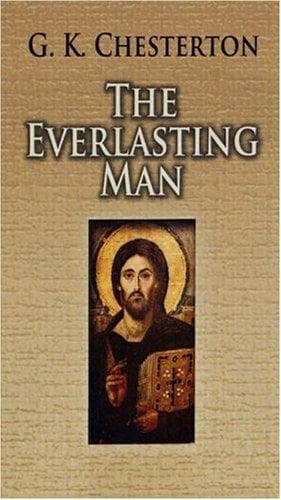
The Everlasting ManChesterton, G. K. (Gilbert Keith)
Religion
The Everlasting Man
Chesterton, G. K. (Gilbert Keith)
Catholic Church -- Apologetic works; Christianity and other religions; Religion
No, if the ‘ecclesiastical
and dogmatic system’ is as old as Pentecost it is as old as Christmas.
If we trace it back to such very early Christians we must trace it back
to Christ.
We may begin then with these two negations. It is nonsense to say that
the Christian faith appeared in a simple age; in the sense of an
unlettered and gullible age. It is equally nonsense to say that the
Christian faith was a simple thing; in the sense of a vague or childish
or merely instinctive thing. Perhaps the only point in which we could
possibly say that the Church fitted into the pagan world is the fact
that they were both not only highly civilised but rather complicated.
They were both emphatically many-sided; but antiquity was then a
many-sided hole, like a hexagonal hole waiting for an equally hexagonal
stopper. In that sense only the Church was many-sided enough to fit the
world. The six sides of the Mediterranean world faced each other across
the sea and waited for something that should look all ways at once. The
Church had to be both Roman and Greek and Jewish and African and
Asiatic. In the very words of the Apostle of the Gentiles, it was indeed
all things to all men. Christianity then was not merely crude and
simple, and was the very reverse of the growth of a barbaric time. But
when we come to the contrary charge, we come to a much more plausible
charge. It is very much more tenable that the Faith was but the final
phase of the decay of civilisation, in the sense of the excess of
civilisation; that this superstition was a sign that Rome was dying, and
dying of being much too civilised. That is an argument much better worth
considering; and we will proceed to consider it.
At the beginning of this book I ventured on a general summary of it, in
a parallel between the rise of humanity out of nature and the rise of
Christianity out of history. I pointed out that in both cases what had
gone before might imply something coming after; but did not in the least
imply what did come after. If a detached mind had seen certain apes it
might have deduced more anthropoids; it would not have deduced man or
anything within a thousand miles of what man has done. In short, it
might have seen Pithacanthropus or the Missing Link looming in the
future, if possible almost as dimly and doubtfully as we see him looming
in the past. But if it foresaw him appearing it would also foresee him
disappearing, and leaving a few faint traces just as he has left a few
faint traces; if they are traces. To foresee that Missing Link would not
be to foresee Man, or anything like Man. Now this earlier explanation
must be kept in mind; because it is an exact parallel to the true view
of the Church; and the suggestion of it having evolved naturally out of
the Empire in decay.
Public-domain text, read in full here on John Shaqi.
Reviews
Reviews
No reviews yet
Be the first to share your thoughts on this work.
Elsewhere in the archive
Join the Discussion
Join the discussion
Sign in to leave a comment or review.
Sign InorCreate an account