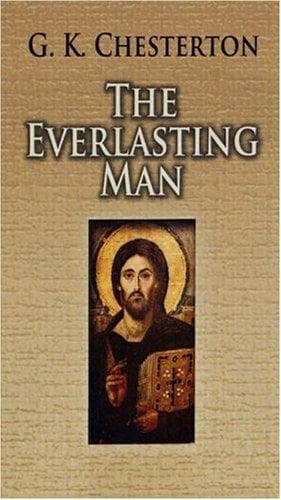
The Everlasting ManChesterton, G. K. (Gilbert Keith)
Religion
The Everlasting Man
Chesterton, G. K. (Gilbert Keith)
Catholic Church -- Apologetic works; Christianity and other religions; Religion
Even where we might trace in dotted lines the domains of Asiatic
religions, we should probably be reading into them something dogmatic
and ethical belonging to our own religion. It is as if a European
ignorant of the American atmosphere were to suppose that each ‘state’
was a separate sovereign state as patriotic as France or Poland; or that
when a Yankee referred fondly to his ‘home town’ he meant he had no
other nation, like a citizen of ancient Athens or Rome. As he would be
reading a particular sort of loyalty into America, so we are reading a
particular sort of loyalty into Asia. There are loyalties of other
kinds; but not what men on the West mean by being a believer, by trying
to be a Christian, by being a good Protestant or a practising Catholic.
In the intellectual world it means something far more vague and varied
by doubts and speculations. In the moral world it means something far
more loose and drifting. A professor of Persian at one of our great
universities, so passionate a partisan of the East as practically to
profess a contempt for the West, said to a friend of mine: ‘You will
never understand oriental religions, because you always conceive
religion as connected with ethics. This kind has really nothing to do
with ethics.’ We have most of us known some Masters of the Higher
Wisdom, some Pilgrims upon the Path to Power, some eastern esoteric
saints and seers, who had really nothing to do with ethics. Something
different, something detached and irresponsible, tinges the moral
atmosphere of Asia and touches even that of Islam. It was very
realistically caught in the atmosphere of _Hassan_; and a very horrible
atmosphere too. It is even more vivid in such glimpses as we get of the
genuine and ancient cults of Asia. Deeper than the depths of
metaphysics, far down in the abysses of mystical meditations, under all
that solemn universe of spiritual things, is a secret, an intangible and
a terrible levity. It does not really very much matter what one does.
Either because they do not believe in a devil, or because they do
believe in a destiny, or because experience here is everything and
eternal life something totally different, but for some reason they are
totally different. I have read somewhere that there were three great
friends famous in medieval Persia for their unity of mind. One became
the responsible and respected Vizier of the Great King; the second was
the poet Omar, pessimist and epicurean, drinking wine in mockery of
Mahomet; the third was the Old Man of the Mountain who maddened his
people with hashish that they might murder other people with daggers. It
does not really much matter what one does.
Public-domain text, read in full here on John Shaqi.
Reviews
Reviews
No reviews yet
Be the first to share your thoughts on this work.
Elsewhere in the archive
Join the Discussion
Join the discussion
Sign in to leave a comment or review.
Sign InorCreate an account