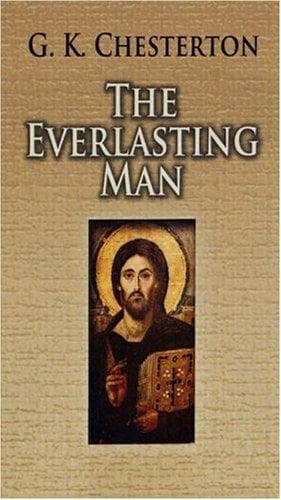
The Everlasting ManChesterton, G. K. (Gilbert Keith)
Religion
The Everlasting Man
Chesterton, G. K. (Gilbert Keith)
Catholic Church -- Apologetic works; Christianity and other religions; Religion
The Sultan in _Hassan_ would have understood all those three men; indeed
he was all those three men. But this sort of universalist cannot have
what we call a character; it is what we call a chaos. He cannot choose;
he cannot fight; he cannot repent; he cannot hope. He is not in the same
sense creating something; for creation means rejection. He is not, in
our religious phrase, making his soul. For our doctrine of salvation
does really mean a labour like that of a man trying to make a statue
beautiful; a victory with wings. For that there must be a final choice;
for a man cannot make statues without rejecting stone. And there really
is this ultimate unmorality behind the metaphysics of Asia. And the
reason is that there has been nothing through all those unthinkable ages
to bring the human mind sharply to the point; to tell it that the time
has come to choose. The mind has lived too much in eternity. The soul
has been too immortal; in the special sense that it ignores the idea of
mortal sin. It has had too much of eternity, in the sense that it has
not had enough of the hour of death and the day of judgment. It is not
crucial enough; in the literal sense that it has not had enough of the
cross. That is what we mean when we say that Asia is very old. But
strictly speaking Europe is quite as old as Asia; indeed in a sense any
place is as old as any other place. What we mean is that Europe has not
merely gone on growing older. It has been born again.
Asia is all humanity; as it has worked out its human doom. Asia, in its
vast territory, in its varied populations, in its heights of past
achievement and its depths of dark speculation, is itself a world; and
represents something of what we mean when we speak of the world. It is a
cosmos rather than a continent. It is the world as man has made it; and
contains many of the most wonderful things that man has made. Therefore
Asia stands as the one representative of paganism and the one rival to
Christendom. But everywhere else where we get glimpses of that mortal
destiny, they suggest stages in the same story. Where Asia trails away
into the southern archipelagoes of the savages, or where a darkness full
of nameless shapes dwells in the heart of Africa, or where the last
survivors of lost races linger in the cold volcano of prehistoric
America, it is all the same story; sometimes perhaps later chapters of
the same story. It is men entangled in the forest of their own
mythology; it is men drowned in the sea of their own metaphysics.
Polytheists have grown weary of the wildest of fictions. Monotheists
have grown weary of the most wonderful of truths. Diabolists here and
there have such a hatred of heaven and earth that they have tried to
take refuge in hell. It is the Fall of Man; and it is exactly that fall
that was being felt by our own fathers at the first moment of the Roman
decline. We also were going down that wide road; down that easy slope;
Public-domain text, read in full here on John Shaqi.
Reviews
Reviews
No reviews yet
Be the first to share your thoughts on this work.
Elsewhere in the archive
Join the Discussion
Join the discussion
Sign in to leave a comment or review.
Sign InorCreate an account