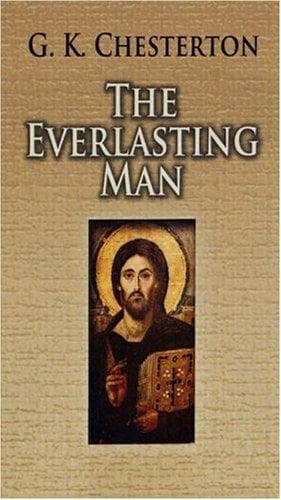
The Everlasting ManChesterton, G. K. (Gilbert Keith)
Religion
The Everlasting Man
Chesterton, G. K. (Gilbert Keith)
Catholic Church -- Apologetic works; Christianity and other religions; Religion
following the magnificent procession of the high civilisations of the
world.
If the Church had not entered the world then, it seems probable that
Europe would be now very much what Asia is now. Something may be allowed
for a real difference of race and environment, visible in the ancient as
in the modern world. But after all we talk about the changeless East
very largely because it has not suffered the great change. Paganism in
its last phase showed considerable signs of becoming equally changeless.
This would not mean that new schools or sects of philosophy would not
arise; as new schools did arise in Antiquity and do arise in Asia. It
does not mean that there would be no real mystics or visionaries; as
there were mystics in Antiquity and are mystics in Asia. It does not
mean that there would be no social codes, as there were codes in
Antiquity and are codes in Asia. It does not mean that there could not
be good men or happy lives, for God has given all men a conscience and
conscience can give all men a kind of peace. But it does mean that the
tone and proportion of all these things, and especially the proportion
of good and evil things, would be in the unchanged West what they are in
the changeless East. And nobody who looks at that changeless East
honestly, and with a real sympathy, can believe that there is anything
there remotely resembling the challenge and revolution of the Faith.
In short, if classic paganism had lingered until now, a number of things
might well have lingered with it; and they would look very like what we
call the religions of the East. There would still be Pythagoreans
teaching reincarnation, as there are still Hindus teaching
reincarnation. There would still be Stoics making a religion out of
reason and virtue, as there are still Confucians making a religion out
of reason and virtue. There would still be Neo-Platonists studying
transcendental truths, the meaning of which was mysterious to other
people and disputed even amongst themselves; as the Buddhists still
study a transcendentalism mysterious to others and disputed among
themselves. There would still be intelligent Apollonians apparently
worshipping the sun-god but explaining that they were worshipping the
divine principle; just as there are still intelligent Parsees apparently
worshipping the sun but explaining that they are worshipping the deity.
There would still be wild Dionysians dancing on the mountain as there
are still wild Dervishes dancing in the desert. There would still be
crowds of people attending the popular feasts of the gods, in pagan
Europe as in pagan Asia. There would still be crowds of gods, local and
other, for them to worship. And there would still be a great many more
people who worshipped them than people who believed in them. Finally
there would still be a very large number of people who did worship gods
and did believe in gods; and who believed in gods and worshipped gods
simply because they were demons. There would still be Levantines
Public-domain text, read in full here on John Shaqi.
Reviews
Reviews
No reviews yet
Be the first to share your thoughts on this work.
Elsewhere in the archive
Join the Discussion
Join the discussion
Sign in to leave a comment or review.
Sign InorCreate an account