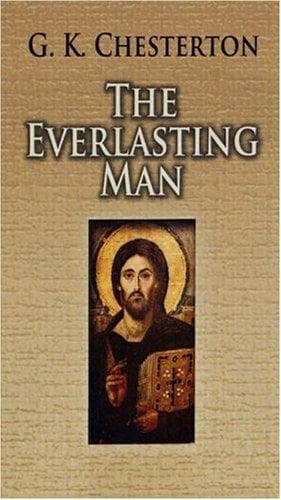
The Everlasting ManChesterton, G. K. (Gilbert Keith)
Religion
The Everlasting Man
Chesterton, G. K. (Gilbert Keith)
Catholic Church -- Apologetic works; Christianity and other religions; Religion
What that universal yet fighting faith brought into the world was hope.
Perhaps the one thing common to mythology and philosophy was that both
were really sad; in the sense that they had not this hope even if they
had touches of faith or charity. We may call Buddhism a faith; though to
us it seems more like a doubt. We may call the Lord of Compassion a Lord
of Charity; though it seems to us a very pessimist sort of pity. But
those who insist most on the antiquity and size of such cults must agree
that in all their ages they have not covered all their areas with that
sort of practical and pugnacious hope. In Christendom hope has never
been absent; rather it has been errant, extravagant, excessively fixed
upon fugitive chances. Its perpetual revolution and reconstruction has
at least been an evidence of people being in better spirits. Europe did
very truly renew its youth like the eagles; just as the eagles of Rome
rose again over the legions of Napoleon, or we have seen soaring but
yesterday the silver eagle of Poland. But in the Polish case even
revolution always went with religion. Napoleon himself sought a
reconciliation with religion. Religion could never be finally separated
even from the most hostile of the hopes; simply because it was the real
source of the hopefulness. And the cause of this is to be found simply
in the religion itself. Those who quarrel about it seldom even consider
it in itself. There is neither space nor place for such a full
consideration here; but a word may be said to explain a reconciliation
that always recurs and still seems to require explanation.
There will be no end to the weary debates about liberalising theology,
until people face the fact that the only liberal part of it is really
the dogmatic part. If dogma is incredible, it is because it is
incredibly liberal. If it is irrational, it can only be in giving us
more assurance of freedom than is justified by reason. The obvious
example is that essential form of freedom which we call free-will. It is
absurd to say that a man shows his liberality in denying his liberty.
But it is tenable that he has to affirm a transcendental doctrine in
order to affirm his liberty. There is a sense in which we might
reasonably say that if man has a primary power of choice, he has in that
fact a supernatural power of creation, as if he could raise the dead or
give birth to the unbegotten. Possibly in that case a man must be a
miracle; and certainly in that case he must be a miracle in order to be
a man; and most certainly in order to be a free man. But it is absurd to
forbid him to be a free man and do it in the name of a more free
religion.
Public-domain text, read in full here on John Shaqi.
Reviews
Reviews
No reviews yet
Be the first to share your thoughts on this work.
Elsewhere in the archive
Join the Discussion
Join the discussion
Sign in to leave a comment or review.
Sign InorCreate an account