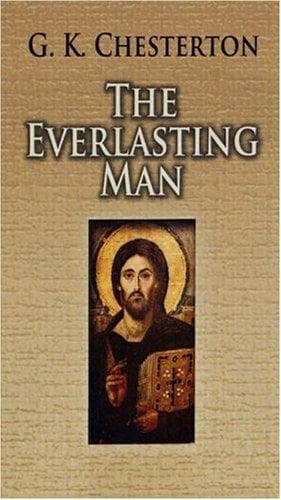
The Everlasting ManChesterton, G. K. (Gilbert Keith)
Religion
The Everlasting Man
Chesterton, G. K. (Gilbert Keith)
Catholic Church -- Apologetic works; Christianity and other religions; Religion
But it is true in twenty other matters. Anybody who believes at all in
God must believe in the absolute supremacy of God. But in so far as that
supremacy does allow of any degrees that can be called liberal or
illiberal, it is self-evident that the illiberal power is the deity of
the rationalists and the liberal power is the deity of the dogmatists.
Exactly in proportion as you turn monotheism into monism you turn it
into despotism. It is precisely the unknown God of the scientist, with
his impenetrable purpose and his inevitable and unalterable law, that
reminds us of a Prussian autocrat making rigid plans in a remote tent
and moving mankind like machinery. It is precisely the God of miracles
and of answered prayers who reminds us of a liberal and popular prince,
receiving petitions, listening to parliaments and considering the cases
of a whole people. I am not now arguing the rationality of this
conception in other respects; as a matter of fact it is not, as some
suppose, irrational; for there is nothing irrational in the wisest and
most well-informed king acting differently according to the action of
those he wishes to save. But I am here only noting the general nature of
liberality, or of free or enlarged atmosphere of action. And in this
respect it is certain that the king can only be what we call magnanimous
if he is what some call capricious. It is the Catholic, who has the
feeling that his prayers do make a difference when offered for the
living and the dead, who also has the feeling of living like a free
citizen in something almost like a constitutional commonwealth. It is
the monist who lives under a single iron law who must have the feeling
of living like a slave under a sultan. Indeed I believe that the
original use of the word _suffragium_, which we now use in politics for
a vote, was that employed in theology about a prayer. The dead in
Purgatory were said to have the suffrages of the living. And in this
sense, of a sort of right of petition to the supreme ruler, we may truly
say that the whole of the Communion of Saints, as well as the whole of
the Church Militant, is founded on universal suffrage.
Public-domain text, read in full here on John Shaqi.
Reviews
Reviews
No reviews yet
Be the first to share your thoughts on this work.
Elsewhere in the archive
Join the Discussion
Join the discussion
Sign in to leave a comment or review.
Sign InorCreate an account