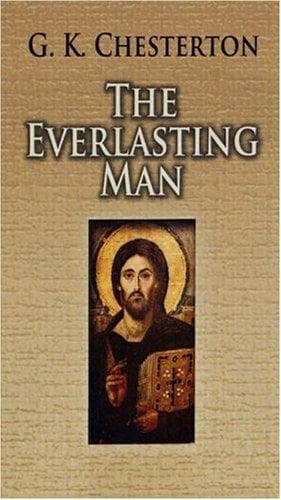
The Everlasting ManChesterton, G. K. (Gilbert Keith)
Religion
The Everlasting Man
Chesterton, G. K. (Gilbert Keith)
Catholic Church -- Apologetic works; Christianity and other religions; Religion
What the denouncer of dogma really means is not that dogma is bad; but
rather that dogma is too good to be true. That is, he means that dogma
is too liberal to be likely. Dogma gives man too much freedom when it
permits him to fall. Dogma gives even God too much freedom when it
permits him to die. That is what the intelligent sceptics ought to say;
and it is not in the least my intention to deny that there is something
to be said for it. They mean that the universe is itself a universal
prison; that existence itself is a limitation and a control; and it is
not for nothing that they call causation a chain. In a word, they mean
quite simply that they cannot believe these things; not in the least
that they are unworthy of belief. We say, not lightly but very
literally, that the truth has made us free. They say that it makes us so
free that it cannot be the truth. To them it is like believing in
fairyland to believe in such freedom as we enjoy. It is like believing
in men with wings to entertain the fancy of men with wills. It is like
accepting a fable about a squirrel in conversation with a mountain to
believe in a man who is free to ask or a God who is free to answer. This
is a manly and a rational negation, for which I for one shall always
show respect. But I decline to show any respect for those who first of
all clip the bird and cage the squirrel, rivet the chains and refuse the
freedom, close all the doors of the cosmic prison on us with a clang of
eternal iron, tell us that our emancipation is a dream and our dungeon a
necessity; and then calmly turn round and tell us they have a freer
thought and a more liberal theology.
The moral of all this is an old one; that religion is revelation. In
other words, it is a vision, and a vision received by faith; but it is a
vision of reality. The faith consists in a conviction of its reality.
That, for example, is the difference between a vision and a day-dream.
And that is the difference between religion and mythology. That is the
difference between faith and all that fancy-work, quite human and more
or less healthy, which we considered under the head of mythology. There
is something in the reasonable use of the very word vision that implies
two things about it; first that it comes very rarely, possibly that it
comes only once; and secondly that it probably comes once and for all. A
day-dream may come every day. A day-dream may be different every day. It
is something more than the difference between telling ghost-stories and
meeting a ghost.
Public-domain text, read in full here on John Shaqi.
Reviews
Reviews
No reviews yet
Be the first to share your thoughts on this work.
Elsewhere in the archive
Join the Discussion
Join the discussion
Sign in to leave a comment or review.
Sign InorCreate an account