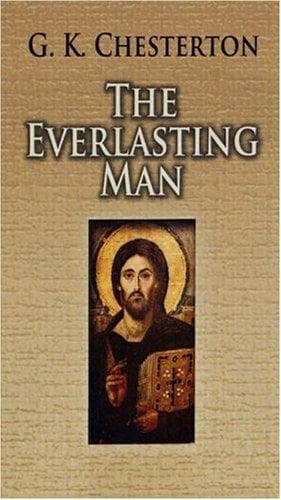
The Everlasting ManChesterton, G. K. (Gilbert Keith)
Religion
The Everlasting Man
Chesterton, G. K. (Gilbert Keith)
Catholic Church -- Apologetic works; Christianity and other religions; Religion
Each
of them starves the story-telling instinct, so to speak, and does
something to spoil human life considered as a romance; either by
fatalism (pessimist or optimist) and that destiny that is the death of
adventure; or by indifference and that detachment that is the death of
drama; or by a fundamental scepticism that dissolves the actors into
atoms; or by a materialistic limitation blocking the vista of moral
consequences; or a mechanical recurrence making even moral tests
monotonous; or a bottomless relativity making even practical tests
insecure. There is such a thing as a human story; and there is such a
thing as the divine story which is also a human story. But there is no
such thing as a Hegelian story or a Monist story or a relativist story
or a determinist story. For every story, yes, even a penny dreadful or a
cheap novelette, has something in it that belongs to our universe and
not theirs. Every short story does truly begin with creation and end
with a last judgment.
And _that_ is the reason why the myths and the philosophers were at war
until Christ came. That is why the Athenian democracy killed Socrates
out of respect for the gods; and why every strolling sophist gave
himself the airs of a Socrates whenever he could talk in a superior
fashion of the gods; and why the heretic Pharaoh wrecked his huge idols
and temples for an abstraction and why the priests could return in
triumph and trample his dynasty under foot; and why Buddhism had to
divide itself from Brahminism, and why in every age and country outside
Christendom there has been a feud for ever between the philosopher and
the priest. It is easy enough to say that the philosopher is generally
the more rational; it is easier still to forget that the priest is
always the more popular. For the priest told the people stories; and the
philosopher did not understand the philosophy of stories. It came into
the world with the story of Christ.
Public-domain text, read in full here on John Shaqi.
Reviews
Reviews
No reviews yet
Be the first to share your thoughts on this work.
Elsewhere in the archive
Join the Discussion
Join the discussion
Sign in to leave a comment or review.
Sign InorCreate an account