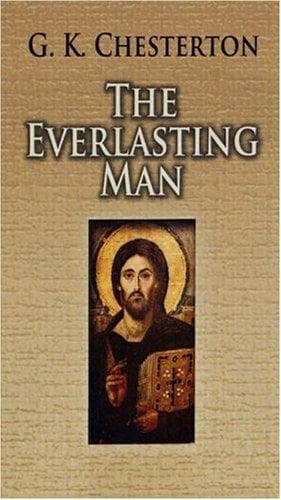
The Everlasting ManChesterton, G. K. (Gilbert Keith)
Religion
The Everlasting Man
Chesterton, G. K. (Gilbert Keith)
Catholic Church -- Apologetic works; Christianity and other religions; Religion
It is a vision which we do in fact symbolise
in pictures by titanic limbs and passionate tints of plumage; all that
abysmal vision of falling stars and the peacock panoplies of the night.
But that strange story has one small advantage over the diagrams. It is
like life.
Another example might be found, not in the problem of evil, but in what
is called the problem of progress. One of the ablest agnostics of the
age once asked me whether I thought mankind grew better or grew worse or
remained the same. He was confident that the alternative covered all
possibilities. He did not see that it only covered patterns and not
pictures; processes and not stories. I asked him whether he thought that
Mr. Smith of Golder’s Green got better or worse or remained exactly the
same between the age of thirty and forty. It then seemed to dawn on him
that it would rather depend on Mr. Smith; and how he chose to go on. It
had never occurred to him that it might depend on how mankind chose to
go on; and that its course was not a straight line or an upward or
downward curve, but a track like that of a man across a valley, going
where he liked and stopping where he chose, going into a church or
falling drunk in a ditch. The life of man is a story; an adventure
story; and in our vision the same is true even of the story of God.
The Catholic faith is the reconciliation because it is the realisation
both of mythology and philosophy. It is a story and in that sense one of
a hundred stories; only it is a true story. It is a philosophy and in
that sense one of a hundred philosophies; only it is a philosophy that
is like life. But above all, it is a reconciliation because it is
something that can only be called the philosophy of stories. That normal
narrative instinct which produced all the fairy-tales is something that
is neglected by all the philosophies--except one. The Faith is the
justification of that popular instinct; the finding of a philosophy for
it or the analysis of the philosophy in it. Exactly as a man in an
adventure story has to pass various tests to save his life, so the man
in this philosophy has to pass several tests and save his soul. In both
there is an idea of free will operating under conditions of design; in
other words, there is an aim and it is the business of a man to aim at
it; we therefore watch to see whether he will hit it. Now this deep and
democratic and dramatic instinct is derided and dismissed in all the
other philosophies. For all the other philosophies avowedly end where
they begin; and it is the definition of a story that it ends
differently; that it begins in one place and ends in another. From
Buddha and his wheel to Akhen-Aten and his disc, from Pythagoras with
his abstraction of number to Confucius with his religion of routine,
there is not one of them that does not in some way sin against the soul
of a story. There is none of them that really grasps this human notion
of the tale, the test, the adventure; the ordeal of the free man.
Public-domain text, read in full here on John Shaqi.
Reviews
Reviews
No reviews yet
Be the first to share your thoughts on this work.
Elsewhere in the archive
Join the Discussion
Join the discussion
Sign in to leave a comment or review.
Sign InorCreate an account