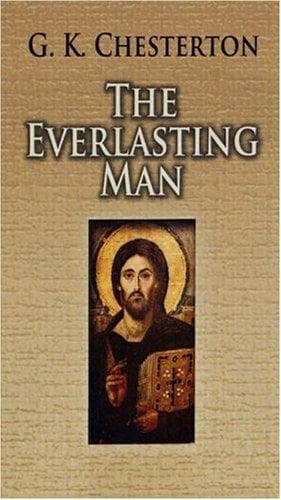
The Everlasting ManChesterton, G. K. (Gilbert Keith)
Religion
The Everlasting Man
Chesterton, G. K. (Gilbert Keith)
Catholic Church -- Apologetic works; Christianity and other religions; Religion
But even with that we return to the more specially Christian symbol in
the same tradition; the perfect pattern of the keys. This is a
historical and not a theological outline, and it is not my duty here to
defend in detail that theology, but merely to point out that it could
not even be justified in design without being justified in detail--like
a key. Beyond the broad suggestion of this chapter I attempt no
apologetic about why the creed should be accepted. But in answer to the
historical query of why it was accepted, and is accepted, I answer for
millions of others in my reply; because it fits the lock; because it is
like life. It is one among many stories; only it happens to be a true
story. It is one among many philosophies; only it happens to be the
truth. We accept it; and the ground is solid under our feet and the road
is open before us. It does not imprison us in a dream of destiny or a
consciousness of the universal delusion. It opens to us not only
incredible heavens, but what seems to some an equally incredible earth,
and makes it credible. This is the sort of truth that is hard to explain
because it is a fact; but it is a fact to which we can call witnesses.
We are Christians and Catholics not because we worship a key, but
because we have passed a door; and felt the wind that is the trumpet of
liberty blow over the land of the living.
CHAPTER VI
THE FIVE DEATHS OF THE FAITH
It is not the purpose of this book to trace the subsequent history of
Christianity, especially the later history of Christianity; which
involves controversies of which I hope to write more fully elsewhere. It
is devoted only to the suggestion that Christianity, appearing amid
heathen humanity, had all the character of a unique thing and even of a
supernatural thing. It was not like any of the other things; and the
more we study it the less it looks like any of them. But there is a
certain rather peculiar character which marked it henceforward even down
to the present moment, with a note on which this book may well conclude.
Public-domain text, read in full here on John Shaqi.
Reviews
Reviews
No reviews yet
Be the first to share your thoughts on this work.
Elsewhere in the archive
Join the Discussion
Join the discussion
Sign in to leave a comment or review.
Sign InorCreate an account