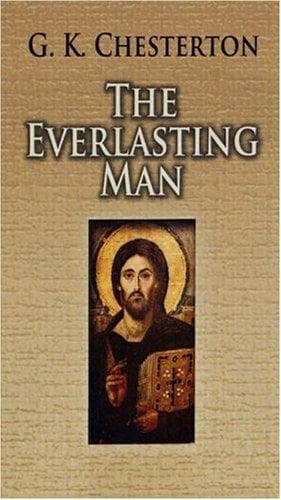
The Everlasting ManChesterton, G. K. (Gilbert Keith)
Religion
The Everlasting Man
Chesterton, G. K. (Gilbert Keith)
Catholic Church -- Apologetic works; Christianity and other religions; Religion
I have said that Asia and the ancient world had an air of being too old
to die. Christendom has had the very opposite fate. Christendom has had
a series of revolutions and in each one of them Christianity has died.
Christianity has died many times and risen again; for it had a god who
knew the way out of the grave. But the first extraordinary fact which
marks this history is this: that Europe has been turned upside down over
and over again; and that at the end of each of these revolutions the
same religion has again been found on top. The Faith is always
converting the age, not as an old religion but as a new religion. This
truth is hidden from many by a convention that is too little noticed.
Curiously enough, it is a convention of the sort which those who ignore
it claim especially to detect and denounce. They are always telling us
that priests and ceremonies are not religion and that religious
organisation can be a hollow sham; but they hardly realise how true it
is. It is so true that three or four times at least in the history of
Christendom the whole soul seemed to have gone out of Christianity; and
almost every man in his heart expected its end. This fact is only masked
in medieval and other times by that very official religion which such
critics pride themselves on seeing through. Christianity remained the
official religion of a Renaissance prince or the official religion of an
eighteenth-century bishop, just as an ancient mythology remained the
official religion of Julius Caesar or the Arian creed long remained the
official religion of Julian the Apostate. But there was a difference
between the cases of Julius and of Julian; because the Church had begun
its strange career. There was no reason why men like Julius should not
worship gods like Jupiter for ever in public and laugh at them for ever
in private. But when Julian treated Christianity as dead, he found it
had come to life again. He also found, incidentally, that there was not
the faintest sign of Jupiter ever coming to life again. This case of
Julian and the episode of Arianism is but the first of a series of
examples that can only be roughly indicated here. Arianism, as has been
said, had every human appearance of being the natural way in which that
particular superstition of Constantine might be expected to peter out.
All the ordinary stages had been passed through; the creed had become a
respectable thing, had become a ritual thing, had then been modified
into a rational thing; and the rationalists were ready to dissipate the
last remains of it, just as they do to-day. When Christianity rose again
suddenly and threw them, it was almost as unexpected as Christ rising
from the dead. But there are many other examples of the same thing, even
about the same time. The rush of missionaries from Ireland, for
instance, has all the air of an unexpected onslaught of young men on an
old world, and even on a Church that showed signs of growing old. Some
Public-domain text, read in full here on John Shaqi.
Reviews
Reviews
No reviews yet
Be the first to share your thoughts on this work.
Elsewhere in the archive
Join the Discussion
Join the discussion
Sign in to leave a comment or review.
Sign InorCreate an account