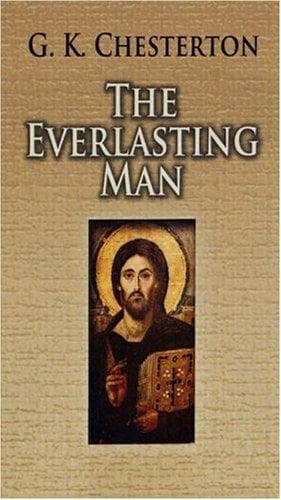
The Everlasting ManChesterton, G. K. (Gilbert Keith)
Religion
The Everlasting Man
Chesterton, G. K. (Gilbert Keith)
Catholic Church -- Apologetic works; Christianity and other religions; Religion
But the Church in the West was not in a world where things were too old
to die; but in one in which they were always young enough to get killed.
The consequence was that superficially and externally it often did get
killed; nay, it sometimes wore out even without getting killed. And
there follows a fact I find it somewhat difficult to describe, yet which
I believe to be very real and rather important. As a ghost is the shadow
of a man, and in that sense the shadow of life, so at intervals there
passed across this endless life a sort of shadow of death. It came at
the moment when it would have perished had it been perishable. It
withered away everything that was perishable. If such animal parallels
were worthy of the occasion, we might say that the snake shuddered and
shed a skin and went on, or even that the cat went into convulsions as
it lost only one of its nine-hundred-and-ninety-nine lives. It is truer
to say, in a more dignified image, that a clock struck and nothing
happened; or that a bell tolled for an execution that was everlastingly
postponed.
What was the meaning of all that dim but vast unrest of the twelfth
century; when, as it has been so finely said, Julian stirred in his
sleep? Why did there appear so strangely early, in the twilight of dawn
after the Dark Ages, so deep a scepticism as that involved in urging
nominalism against realism? For realism against nominalism was really
realism against rationalism, or something more destructive than what we
call rationalism. The answer is that just as some might have thought the
Church simply a part of the Roman Empire, so others later might have
thought the Church only a part of the Dark Ages. The Dark Ages ended as
the Empire had ended; and the Church should have departed with them, if
she had been also one of the shades of night. It was another of those
spectral deaths or simulations of death. I mean that if nominalism had
succeeded, it would have been as if Arianism had succeeded; it would
have been the beginning of a confession that Christianity had failed.
For nominalism is a far more fundamental scepticism than mere atheism.
Such was the question that was openly asked as the Dark Ages broadened
into that daylight that we call the modern world. But what was the
answer? The answer was Aquinas in the chair of Aristotle, taking all
knowledge for his province; and tens of thousands of lads, down to the
lowest ranks of peasant and serf, living in rags and on crusts about the
great colleges, to listen to the scholastic philosophy.
Public-domain text, read in full here on John Shaqi.
Reviews
Reviews
No reviews yet
Be the first to share your thoughts on this work.
Elsewhere in the archive
Join the Discussion
Join the discussion
Sign in to leave a comment or review.
Sign InorCreate an account