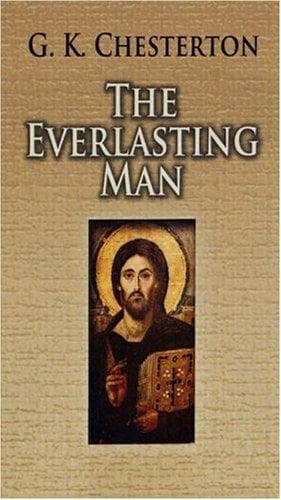
The Everlasting ManChesterton, G. K. (Gilbert Keith)
Religion
The Everlasting Man
Chesterton, G. K. (Gilbert Keith)
Catholic Church -- Apologetic works; Christianity and other religions; Religion
‘Heaven and earth shall pass away, but my words shall not pass away.’
The civilisation of antiquity was the whole world: and men no more
dreamed of its ending than of the ending of daylight. They could not
imagine another order unless it were in another world. The civilisation
of the world has passed away and those words have not passed away. In
the long night of the Dark Ages feudalism was so familiar a thing that
no man could imagine himself without a lord: and religion was so woven
into that network that no man would have believed they could be torn
asunder. Feudalism itself was torn to rags and rotted away in the
popular life of the true Middle Ages; and the first and freshest power
in that new freedom was the old religion. Feudalism had passed away, and
the words did not pass away. The whole medieval order, in many ways so
complete and almost cosmic a home for man, wore out gradually in its
turn: and here at least it was thought that the words would die. They
went forth across the radiant abyss of the Renaissance and in fifty
years were using all its light and learning for new religious
foundations, new apologetics, new saints. It was supposed to have been
withered up at last in the dry light of the Age of Reason; it was
supposed to have disappeared ultimately in the earthquake of the Age of
Revolution. Science explained it away; and it was still there. History
disinterred it in the past; and it appeared suddenly in the future.
To-day it stands once more in our path; and even as we watch it, it
grows.
If our social relations and records retain their continuity, if men
really learn to apply reason to the accumulating facts of so crushing a
story, it would seem that sooner or later even its enemies will learn
from their incessant and interminable disappointments not to look for
anything so simple as its death. They may continue to war with it, but
it will be as they war with nature; as they war with the landscape, as
they war with the skies. ‘Heaven and earth shall pass away, but my words
shall not pass away.’ They will watch for it to stumble; they will watch
for it to err; they will no longer watch for it to end. Insensibly, even
unconsciously, they will in their own silent anticipations fulfil the
relative terms of that astounding prophecy; they will forget to watch
for the mere extinction of what has so often been vainly extinguished;
and will learn instinctively to look first for the coming of the comet
or the freezing of the star.
CONCLUSION
THE SUMMARY OF THIS BOOK
Public-domain text, read in full here on John Shaqi.
Reviews
Reviews
No reviews yet
Be the first to share your thoughts on this work.
Elsewhere in the archive
Join the Discussion
Join the discussion
Sign in to leave a comment or review.
Sign InorCreate an account