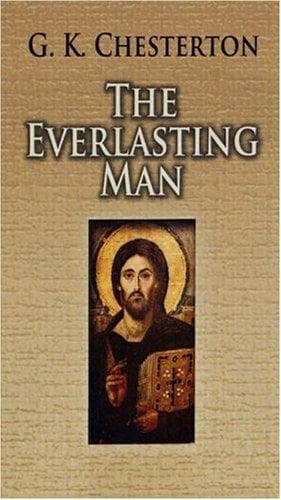
The Everlasting ManChesterton, G. K. (Gilbert Keith)
Religion
The Everlasting Man
Chesterton, G. K. (Gilbert Keith)
Catholic Church -- Apologetic works; Christianity and other religions; Religion
I have taken the liberty once or twice of borrowing the excellent phrase
about an Outline of History; though this study of a special truth and a
special error can of course claim no sort of comparison with the rich
and many-sided encyclopedia of history, for which that name was chosen.
And yet there is a certain reason in the reference; and a sense in which
the one thing touches and even cuts across the other. For the story of
the world as told by Mr. Wells could here only be criticised as an
outline. And, strangely enough, it seems to me that it is only wrong as
an outline. It is admirable as an accumulation of history; it is
splendid as a storehouse or treasury of history; it is a fascinating
disquisition on history; it is most attractive as an amplification of
history; but it is quite false as an outline of history. The one thing
that seems to me quite wrong about it is the outline; the sort of
outline that can really be a single line, like that which makes all the
difference between a caricature of the profile of Mr. Winston Churchill
and of Sir Alfred Mond. In simple and homely language, I mean the things
that stick out; the things that make the simplicity of a silhouette. I
think the proportions are wrong; the proportions of what is certain as
compared with what is uncertain, of what played a great part as compared
with what played a smaller part, of what is ordinary and what is
extraordinary, of what really lies level with an average and what stands
out as an exception.
I do not say it as a small criticism of a great writer, and I have no
reason to do so; for in my own much smaller task I feel I have failed in
very much the same way. I am very doubtful whether I have conveyed to
the reader the main point I meant about the proportions of history, and
why I have dwelt so much more on some things than others. I doubt
whether I have clearly fulfilled the plan that I set out in the
introductory chapter; and for that reason I add these lines as a sort of
summary in a concluding chapter. I do believe that the things on which I
have insisted are more essential to an outline of history than the
things which I have subordinated or dismissed. I do not believe that the
past is most truly pictured as a thing in which humanity merely fades
away into nature, or civilisation merely fades away into barbarism, or
religion fades away into mythology, or our own religion fades away into
the religions of the world. In short I do not believe that the best way
to produce an outline of history is to rub out the lines. I believe
that, of the two, it would be far nearer the truth to tell the tale very
simply, like a primitive myth about a man who made the sun and stars or
a god who entered the body of a sacred monkey. I will therefore sum up
all that has gone before in what seems to me a realistic and reasonably
proportioned statement; the short story of mankind.
Public-domain text, read in full here on John Shaqi.
Reviews
Reviews
No reviews yet
Be the first to share your thoughts on this work.
Elsewhere in the archive
Join the Discussion
Join the discussion
Sign in to leave a comment or review.
Sign InorCreate an account