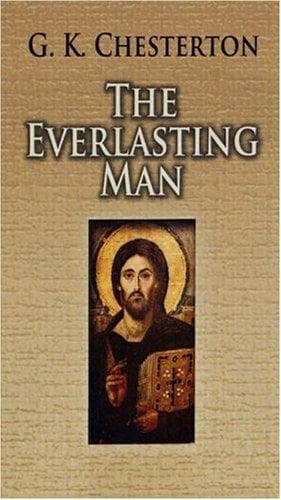
The Everlasting ManChesterton, G. K. (Gilbert Keith)
Religion
The Everlasting Man
Chesterton, G. K. (Gilbert Keith)
Catholic Church -- Apologetic works; Christianity and other religions; Religion
Meanwhile the minority, the sages or thinkers, had withdrawn apart and
had taken up an equally congenial trade. They were drawing up plans of
the world; of the world which all believed to have a plan. They were
trying to set forth the plan seriously and to scale. They were setting
their minds directly to the mind that had made the mysterious world;
considering what sort of a mind it might be and what its ultimate
purpose might be. Some of them made that mind much more impersonal than
mankind has generally made it; some simplified it almost to a blank; a
few, a very few, doubted it altogether. One or two of the more morbid
fancied that it might be evil and an enemy; just one or two of the more
degraded in the other class worshipped demons instead of gods. But most
of these theorists were theists: and they not only saw a moral plan in
nature, but they generally laid down a moral plan for humanity. Most of
them were good men who did good work: and they were remembered and
reverenced in various ways. They were scribes; and their scriptures
became more or less holy scriptures. They were law-givers; and their
tradition became not only legal but ceremonial. We may say that they
received divine honours, in the sense in which kings and great captains
in certain countries often received divine honours. In a word, wherever
the other popular spirit, the spirit of legend and gossip, could come
into play, it surrounded them with the more mystical atmosphere of the
myths. Popular poetry turned the sages into saints. But that was all it
did. They remained themselves; men never really forgot that they were
men, only made into gods in the sense that they were made into heroes.
Divine Plato, like Divus Caesar, was a title and not a dogma. In Asia,
where the atmosphere was more mythological, the man was made to look
more like a myth, but he remained a man. He remained a man of a certain
special class or school of men, receiving and deserving great honour
from mankind. It is the order or school of the philosophers; the men who
have set themselves seriously to trace the order across any apparent
chaos in the vision of life. Instead of living on imaginative rumours
and remote traditions and the tail-end of exceptional experiences about
the mind and meaning behind the world, they have tried in a sense to
project the primary purpose of that mind _a priori_. They have tried to
put on paper a possible plan of the world; almost as if the world were
not yet made.
Public-domain text, read in full here on John Shaqi.
Reviews
Reviews
No reviews yet
Be the first to share your thoughts on this work.
Elsewhere in the archive
Join the Discussion
Join the discussion
Sign in to leave a comment or review.
Sign InorCreate an account