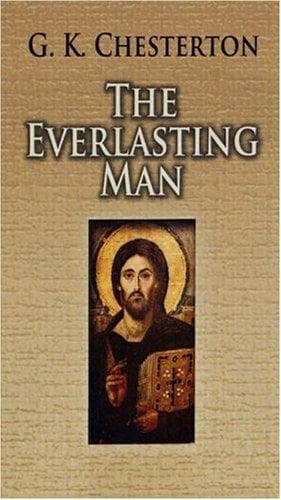
The Everlasting ManChesterton, G. K. (Gilbert Keith)
Religion
The Everlasting Man
Chesterton, G. K. (Gilbert Keith)
Catholic Church -- Apologetic works; Christianity and other religions; Religion
There was a stranger who was also a friend; a mysterious
benefactor who had been before them and built up the woods and hills for
their coming, and had kindled the sunrise against their rising, as a
servant kindles a fire. Now this idea of a mind that gives a meaning to
the universe has received more and more confirmation within the minds of
men, by meditations and experiences much more subtle and searching than
any such argument about the external plan of the world. But I am
concerned here with keeping the story in its most simple and even
concrete terms; and it is enough to say here that most men, including
the wisest men, have come to the conclusion that the world has such a
final purpose and therefore such a first cause. But most men in some
sense separated themselves from the wisest men, when it came to the
treatment of that idea. There came into existence two ways of treating
that idea; which between them make up most of the religious history of
the world.
The majority, like the minority, had this strong sense of a second
meaning in things; of a strange master who knew the secret of the world.
But the majority, the mob or mass of men, naturally tended to treat it
rather in the spirit of gossip. The gossip, like all gossip, contained a
great deal of truth and falsehood. The world began to tell itself tales
about the unknown being or his sons or servants or messengers. Some of
the tales may truly be called old wives’ tales; as professing only to be
very remote memories of the morning of the world; myths about the baby
moon or the half-baked mountains. Some of them might more truly be
called travellers’ tales; as being curious but contemporary tales
brought from certain borderlands of experience; such as miraculous
cures or those that bring whispers of what has happened to the dead.
Many of them are probably true tales; enough of them are probably true
to keep a person of real common sense more or less conscious that there
really is something rather marvellous behind the cosmic curtain. But in
a sense it is only going by appearances; even if the appearances are
called apparitions. It is a matter of appearances--and disappearances.
At the most these gods are ghosts; that is, they are glimpses. For most
of us they are rather gossip about glimpses. And for the rest, the whole
world is full of rumours, most of which are almost avowedly romances.
The great majority of the tales about gods and ghosts and the invisible
king are told, if not for the sake of the tale, at least for the sake of
the topic. They are evidence of the eternal interest of the theme; they
are not evidence of anything else, and they are not meant to be. They
are mythology, or the poetry that is not bound in books--or bound in any
other way.
Public-domain text, read in full here on John Shaqi.
Reviews
Reviews
No reviews yet
Be the first to share your thoughts on this work.
Elsewhere in the archive
Join the Discussion
Join the discussion
Sign in to leave a comment or review.
Sign InorCreate an account