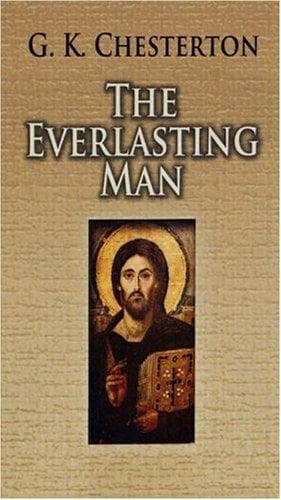
The Everlasting ManChesterton, G. K. (Gilbert Keith)
Religion
The Everlasting Man
Chesterton, G. K. (Gilbert Keith)
Catholic Church -- Apologetic works; Christianity and other religions; Religion
But when we translate the terms of that strange tale back into the more
concrete and complicated terminology of our time, we find it covered by
names and memories of which the very familiarity is a falsification. For
instance, when we say that a country contains so many Moslems, we really
mean that it contains so many monotheists; and we really mean, by that,
that it contains so many men; men with the old average assumption of
men--that the invisible ruler remains invisible. They hold it along with
the customs of a certain culture and under the simpler laws of a certain
law-giver; but so they would if their law-giver were Lycurgus or Solon.
They testify to something which is a necessary and noble truth; but was
never a new truth. Their creed is not a new colour; it is the neutral
and normal tint that is the background of the many-coloured life of man.
Mahomet did not, like the Magi, find a new star; he saw through his own
particular window a glimpse of the great grey field of the ancient
starlight. So when we say that the country contains so many Confucians
or Buddhists, we mean that it contains so many Pagans whose prophets
have given them another and rather vaguer version of the invisible
power; making it not only invisible but almost impersonal. When we say
that they also have temples and idols and priests and periodical
festivals, we simply mean that this sort of heathen is enough of a human
being to admit the popular element of pomp and pictures and feasts and
fairy-tales. We only mean that Pagans have more sense than Puritans. But
what the gods are supposed to _be_, what the priests are commissioned to
_say_, is not a sensational secret like what those running messengers of
the Gospel had to say. Nobody else except those messengers has any
Gospel; nobody else has any good news; for the simple reason that nobody
else has any news.
Those runners gather impetus as they run. Ages afterwards they still
speak as if something had just happened. They have not lost the speed
and momentum of messengers; they have hardly lost, as it were, the wild
eyes of witnesses. In the Catholic Church, which is the cohort of the
message, there are still those headlong acts of holiness that speak of
something rapid and recent; a self-sacrifice that startles the world
like a suicide. But it is not a suicide; it is not pessimistic; it is
still as optimistic as St. Francis of the flowers and birds. It is newer
in spirit than the newest schools of thought; and it is almost certainly
on the eve of new triumphs. For these men serve a mother who seems to
grow more beautiful as new generations rise up and call her blessed. We
might sometimes fancy that the Church grows younger as the world grows
old.
Public-domain text, read in full here on John Shaqi.
Reviews
Reviews
No reviews yet
Be the first to share your thoughts on this work.
Elsewhere in the archive
Join the Discussion
Join the discussion
Sign in to leave a comment or review.
Sign InorCreate an account