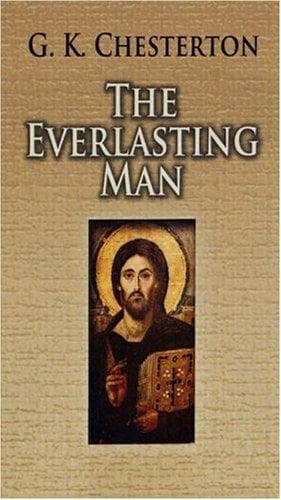
The Everlasting ManChesterton, G. K. (Gilbert Keith)
Religion
The Everlasting Man
Chesterton, G. K. (Gilbert Keith)
Catholic Church -- Apologetic works; Christianity and other religions; Religion
For this is the last proof of the miracle; that something so
supernatural should have become so natural. I mean that anything so
unique when seen from the outside should only seem universal when seen
from the inside. I have not minimised the scale of the miracle, as some
of our milder theologians think it wise to do. Rather have I
deliberately dwelt on that incredible interruption, as a blow that broke
the very backbone of history. I have great sympathy with the
monotheists, the Moslems, or the Jews, to whom it seems a blasphemy; a
blasphemy that might shake the world. But it did not shake the world; it
steadied the world. That fact, the more we consider it, will seem more
solid and more strange. I think it a piece of plain justice to all the
unbelievers to insist upon the audacity of the act of faith that is
demanded of them. I willingly and warmly agree that it is, in itself, a
suggestion at which we might expect even the brain of the believer to
reel, when he realised his own belief. But the brain of the believer
does not reel; it is the brains of the unbelievers that reel. We can see
their brains reeling on every side and into every extravagance of ethics
and psychology; into pessimism and the denial of life; into pragmatism
and the denial of logic; seeking their omens in nightmares and their
canons in contradictions; shrieking for fear at the far-off sight of
things beyond good and evil, or whispering of strange stars where two
and two make five. Meanwhile this solitary thing that seems at first so
outrageous in outline remains solid and sane in substance. It remains
the moderator of all these manias; rescuing reason from the Pragmatists
exactly as it rescued laughter from the Puritans. I repeat that I have
deliberately emphasised its intrinsically defiant and dogmatic
character. The mystery is how anything so startling should have remained
defiant and dogmatic and yet become perfectly normal and natural. I have
admitted freely that, considering the incident in itself, a man who says
he is God may be classed with a man who says he is glass. But the man
who says he is glass is not a glazier making windows for all the world.
He does not remain for after ages as a shining and crystalline figure,
in whose light everything is as clear as crystal.
Public-domain text, read in full here on John Shaqi.
Reviews
Reviews
No reviews yet
Be the first to share your thoughts on this work.
Elsewhere in the archive
Join the Discussion
Join the discussion
Sign in to leave a comment or review.
Sign InorCreate an account