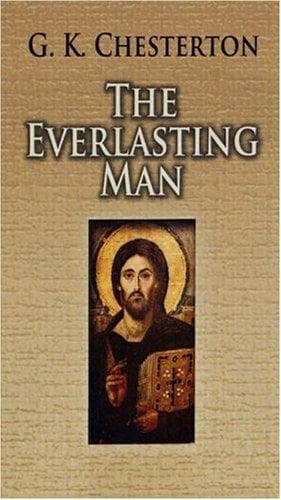
The Everlasting ManChesterton, G. K. (Gilbert Keith)
Religion
The Everlasting Man
Chesterton, G. K. (Gilbert Keith)
Catholic Church -- Apologetic works; Christianity and other religions; Religion
It is not natural to see man as a natural product. It is not common
sense to call man a common object of the country or the seashore. It is
not seeing straight to see him as an animal. It is not sane. It sins
against the light; against that broad daylight of proportion which is
the principle of all reality. It is reached by stretching a point, by
making out a case, by artificially selecting a certain light and shade,
by bringing into prominence the lesser or lower things which may happen
to be similar. The solid thing standing in the sunlight, the thing we
can walk round and see from all sides, is quite different. It is also
quite extraordinary; and the more sides we see of it the more
extraordinary it seems. It is emphatically not a thing that follows or
flows naturally from anything else. If we imagine that an inhuman or
impersonal intelligence could have felt from the first the general
nature of the non-human world sufficiently to see that things would
evolve in whatever way they did evolve, there would have been nothing
whatever in all that natural world to prepare such a mind for such an
unnatural novelty. To such a mind, man would most certainly not have
seemed something like one herd out of a hundred herds finding richer
pasture; or one swallow out of a hundred swallows making a summer under
a strange sky. It would not be in the same scale and scarcely in the
same dimension. We might as truly say that it would not be in the same
universe. It would be more like seeing one cow out of a hundred cows
suddenly jump over the moon or one pig out of a hundred pigs grow wings
in a flash and fly. It would not be a question of the cattle finding
their own grazing-ground but of their building their own cattle-sheds,
not a question of one swallow making a summer but of his making a
summer-house. For the very fact that birds do build nests is one of
those similarities that sharpen the startling difference. The very fact
that a bird can get as far as building a nest, and cannot get any
farther, proves that he has not a mind as man has a mind; it proves it
more completely than if he built nothing at all. If he built nothing at
all, he might possibly be a philosopher of the Quietist or Buddhistic
school, indifferent to all but the mind within. But when he builds as he
does build and is satisfied and sings aloud with satisfaction, then we
know there is really an invisible veil like a pane of glass between him
and us, like the window on which a bird will beat in vain. But suppose
our abstract onlooker saw one of the birds begin to build as men build.
Suppose in an incredibly short space of time there were seven styles of
architecture for one style of nest. Suppose the bird carefully selected
forked twigs and pointed leaves to express the piercing piety of Gothic,
but turned to broad foliage and black mud when he sought in a darker
mood to call up the heavy columns of Bel and Ashtaroth; making his nest
indeed one of the hanging gardens of Babylon.
Public-domain text, read in full here on John Shaqi.
Reviews
Reviews
No reviews yet
Be the first to share your thoughts on this work.
Join the Discussion
Join the discussion
Sign in to leave a comment or review.
Sign InorCreate an account