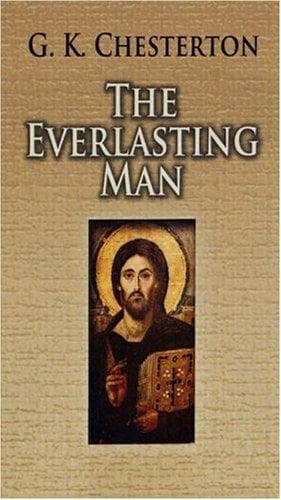
The Everlasting ManChesterton, G. K. (Gilbert Keith)
Religion
The Everlasting Man
Chesterton, G. K. (Gilbert Keith)
Catholic Church -- Apologetic works; Christianity and other religions; Religion
That way lies all that is at
once awful and familiar and forgotten, with dreadful faces thronged and
fiery arms. We can accept man as a fact, if we are content with an
unexplained fact. We can accept him as an animal, if we can live with a
fabulous animal. But if we must needs have sequence and necessity, then
indeed we must provide a prelude and crescendo of mounting miracles,
that ushered in with unthinkable thunders in all the seven heavens of
another order, a man may be an ordinary thing.
CHAPTER II
PROFESSORS AND PREHISTORIC MEN
Science is weak about these prehistoric things in a way that has hardly
been noticed. The science whose modern marvels we all admire succeeds by
incessantly adding to its data. In all practical inventions, in most
natural discoveries, it can always increase evidence by experiment. But
it cannot experiment in making men; or even in watching to see what the
first men make. An inventor can advance step by step in the construction
of an aeroplane, even if he is only experimenting with sticks and scraps
of metal in his own back-yard. But he cannot watch the Missing Link
evolving in his own back-yard. If he has made a mistake in his
calculations, the aeroplane will correct it by crashing to the ground.
But if he has made a mistake about the arboreal habitat of his ancestor,
he cannot see his arboreal ancestor falling off the tree. He cannot keep
a cave-man like a cat in the back-yard and watch him to see whether he
does really practise cannibalism or carry off his mate on the principles
of marriage by capture. He cannot keep a tribe of primitive men like a
pack of hounds and notice how far they are influenced by the herd
instinct. If he sees a particular bird behave in a particular way, he
can get other birds and see if they behave in that way; but if he finds
a skull, or the scrap of a skull, in the hollow of a hill, he cannot
multiply it into a vision of the valley of dry bones. In dealing with a
past that has almost entirely perished, he can only go by evidence and
not by experiment. And there is hardly enough evidence to be even
evidential. Thus while most science moves in a sort of curve, being
constantly corrected by new evidence, this science flies off into space
in a straight line uncorrected by anything. But the habit of forming
conclusions, as they can really be formed in more fruitful fields, is so
fixed in the scientific mind that it cannot resist talking like this. It
talks about the idea suggested by one scrap of bone as if it were
something like the aeroplane which is constructed at last out of whole
scrap-heaps of scraps of metal. The trouble with the professor of the
prehistoric is that he cannot scrap his scrap. The marvellous and
triumphant aeroplane is made out of a hundred mistakes. The student of
origins can only make one mistake and stick to it.
Public-domain text, read in full here on John Shaqi.
Reviews
Reviews
No reviews yet
Be the first to share your thoughts on this work.
Join the Discussion
Join the discussion
Sign in to leave a comment or review.
Sign InorCreate an account