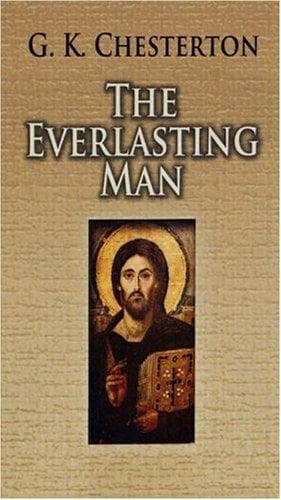
The Everlasting ManChesterton, G. K. (Gilbert Keith)
Religion
The Everlasting Man
Chesterton, G. K. (Gilbert Keith)
Catholic Church -- Apologetic works; Christianity and other religions; Religion
Another distinguished writer, again, in commenting on the cave-drawings
attributed to the neolithic men of the reindeer period, said that none
of their pictures appeared to have any religious purpose; and he seemed
almost to infer that they had no religion. I can hardly imagine a
thinner thread of argument than this which reconstructs the very inmost
moods of the prehistoric mind from the fact that somebody who has
scrawled a few sketches on a rock, from what motive we do not know, for
what purpose we do not know, acting under what customs or conventions we
do not know, may possibly have found it easier to draw reindeers than to
draw religion. He may have drawn it because it was his religious symbol.
He may have drawn it because it was not his religious symbol. He may
have drawn anything except his religious symbol. He may have drawn his
real religious symbol somewhere else; or it may have been deliberately
destroyed when it was drawn. He may have done or not done half a million
things; but in any case it is an amazing leap of logic to infer that he
had no religious symbol, or even to infer from his having no religious
symbol that he had no religion. Now this particular case happens to
illustrate the insecurity of these guesses very clearly. For a little
while afterwards, people discovered not only paintings but sculptures of
animals in the caves. Some of these were said to be damaged with dints
or holes supposed to be the marks of arrows; and the damaged images were
conjectured to be the remains of some magic rite of killing the beasts
in effigy; while the undamaged images were explained in connection with
another magic rite invoking fertility upon the herds. Here again there
is something faintly humorous about the scientific habit of having it
both ways. If the image is damaged it proves one superstition and if it
is undamaged it proves another. Here again there is a rather reckless
jumping to conclusions; it has hardly occurred to the speculators that a
crowd of hunters imprisoned in winter in a cave might conceivably have
aimed at a mark for fun, as a sort of primitive parlour game. But in any
case, if it was done out of superstition, what has become of the thesis
that it had nothing to do with religion? The truth is that all this
guesswork has nothing to do with anything. It is not half such a good
parlour game as shooting arrows at a carved reindeer, for it is shooting
them into the air.
Public-domain text, read in full here on John Shaqi.
Reviews
Reviews
No reviews yet
Be the first to share your thoughts on this work.
Join the Discussion
Join the discussion
Sign in to leave a comment or review.
Sign InorCreate an account