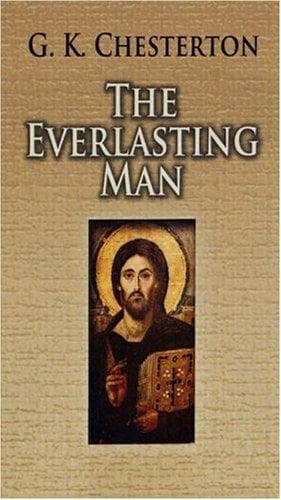
The Everlasting ManChesterton, G. K. (Gilbert Keith)
Religion
The Everlasting Man
Chesterton, G. K. (Gilbert Keith)
Catholic Church -- Apologetic works; Christianity and other religions; Religion
father and mother of all laws as it is itself founded on a father and
mother: the thing that is before all thrones and even all commonwealths.
That fact is the family. Here again we must keep the enormous
proportions of a normal thing clear of various modifications and degrees
and doubts more or less reasonable, like clouds clinging about a
mountain. It may be that what we call the family had to fight its way
from or through various anarchies and aberrations; but it certainly
survived them and is quite as likely as not to have also preceded them.
As we shall see in the case of communism and nomadism, more formless
things could and did lie on the flank of societies that had taken a
fixed form; but there is nothing to show that the form did not exist
before the formlessness. What is vital is that form is more important
than formlessness; and that the material called mankind has taken this
form. For instance, of the rules revolving round sex, which were
recently mentioned, none is more curious than the savage custom commonly
called the _couvade_. That seems like a law out of topsyturvydom; by
which the father is treated as if he were the mother. In any case it
clearly involves the mystical sense of sex; but many have maintained
that it is really a symbolic act by which the father accepts the
responsibility of fatherhood. In that case that grotesque antic is
really a very solemn act; for it is the foundation of all we call the
family and all we know as human society. Some groping in these dark
beginnings have said that mankind was once under a matriarchy; I suppose
that under a matriarchy it would not be called mankind but womankind.
But others have conjectured that what is called matriarchy was simply
moral anarchy, in which the mother alone remained fixed because all the
fathers were fugitive and irresponsible. Then came the moment when the
man decided to guard and guide what he had created. So he became the
head of the family, not as a bully with a big club to beat women with,
but rather as a respectable person trying to be a responsible person.
Now all that might be perfectly true, and might even have been the first
family act, and it would still be true that man then for the first time
acted like a man, and therefore for the first time became fully a man.
But it might quite as well be true that the matriarchy or moral anarchy,
or whatever we call it, was only one of the hundred social dissolutions
or barbaric backslidings which may have occurred at intervals in
prehistoric as they certainly did in historic times. A symbol like the
_couvade_, if it was really such a symbol, may have commemorated the
suppression of a heresy rather than the first rise of a religion. We
cannot conclude with any certainty about these things, except in their
big results in the building of mankind, but we can say in what style the
bulk of it and the best of it is built. We can say that the family is
Public-domain text, read in full here on John Shaqi.
Reviews
Reviews
No reviews yet
Be the first to share your thoughts on this work.
Join the Discussion
Join the discussion
Sign in to leave a comment or review.
Sign InorCreate an account