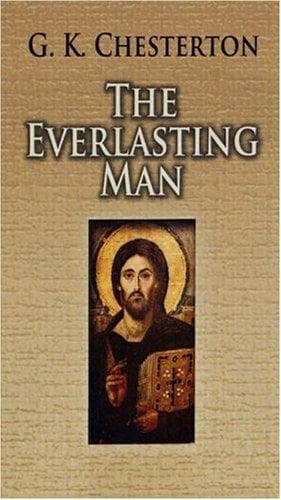
The Everlasting ManChesterton, G. K. (Gilbert Keith)
Religion
The Everlasting Man
Chesterton, G. K. (Gilbert Keith)
Catholic Church -- Apologetic works; Christianity and other religions; Religion
it, we are led to the central fact of civilised history.
That centre was the Mediterranean; which was not so much a piece of
water as a world. But it was a world with something of the character of
such a water; for it became more and more a place of unification in
which the streams of strange and very diverse cultures met. The Nile and
the Tiber alike flow into the Mediterranean; so did the Egyptian and the
Etrurian alike contribute to a Mediterranean civilisation. The glamour
of the great sea spread indeed very far inland, and the unity was felt
among the Arabs alone in the deserts and the Gauls beyond the northern
hills. But the gradual building up of a common culture running round all
the coasts of this inner sea is the main business of antiquity. As will
be seen, it was sometimes a bad business as well as a good business. In
that _orbis terrarum_ or circle of lands there were the extremes of evil
and of piety, there were contrasted races and still more contrasted
religions. It was the scene of an endless struggle between Asia and
Europe from the flight of the Persian ships at Salamis to the flight of
the Turkish ships at Lepanto. It was the scene, as will be more
especially suggested later, of a supreme spiritual struggle between the
two types of paganism, confronting each other in the Latin and the
Phoenician cities; in the Roman forum and the Punic mart. It was the
world of war and peace, the world of good and evil, the world of all
that matters most; with all respect to the Aztecs and the Mongols of
the Far East, they did not matter as the Mediterranean tradition
mattered and still matters. Between it and the Far East there were, of
course, interesting cults and conquests of various kinds, more or less
in touch with it, and in proportion as they were so intelligible also to
us. The Persians came riding in to make an end of Babylon; and we are
told in a Greek story how these barbarians learned to draw the bow and
tell the truth. Alexander the great Greek marched with his Macedonians
into the sunrise, and brought back strange birds coloured like the
sunrise clouds and strange flowers and jewels from the gardens and
treasuries of nameless kings. Islam went eastward into that world and
made it partly imaginable to us; precisely because Islam itself was born
in that circle of lands that fringed our own ancient and ancestral sea.
In the Middle Ages the empire of the Moguls increased its majesty
without losing its mystery; the Tartars conquered China and the Chinese
apparently took very little notice of them. All these things are
interesting in themselves; but it is impossible to shift the centre of
gravity to the inland spaces of Asia from the inland sea of Europe. When
all is said, if there were nothing in the world but what was said and
done and written and built in the lands lying round the Mediterranean,
it would still be in all the most vital and valuable things the world in
which we live.
Public-domain text, read in full here on John Shaqi.
Reviews
Reviews
No reviews yet
Be the first to share your thoughts on this work.
Elsewhere in the archive
Join the Discussion
Join the discussion
Sign in to leave a comment or review.
Sign InorCreate an account