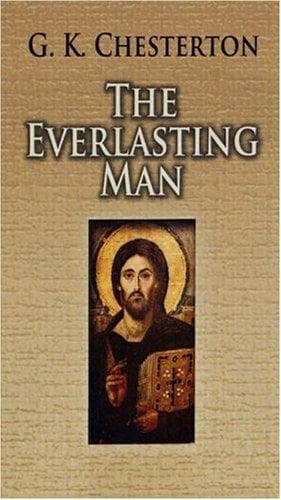
The Everlasting ManChesterton, G. K. (Gilbert Keith)
Religion
The Everlasting Man
Chesterton, G. K. (Gilbert Keith)
Catholic Church -- Apologetic works; Christianity and other religions; Religion
That is what we call a powerful understatement. The modern world is
madder than any satires on it; long ago Mr. Belloc made his burlesque
don say that a bust of Ariadne had been proved by modern research to be
a Silenus. But that is not better than the real appearance of Minerva as
the Bearded Woman of Mr. Barnum. Only both of them are very like many
identifications by ‘the best authorities’ on comparative religion; and
when Catholic creeds are identified with various wild myths, I do not
laugh or curse or misbehave myself; I confine myself decorously to
saying that the identification is not complete.
In the days of my youth the Religion of Humanity was a term commonly
applied to Comtism, the theory of certain rationalists who worshipped
corporate mankind as a Supreme Being. Even in the days of my youth I
remarked that there was something slightly odd about despising and
dismissing the doctrine of the Trinity as a mystical and even maniacal
contradiction; and then asking us to adore a deity who is a hundred
million persons in one God, neither confounding the persons nor dividing
the substance.
But there is another entity, more or less definable and much more
imaginable than the many-headed and monstrous idol of mankind. And it
has a much better right to be called, in a reasonable sense, the
religion of humanity. Man is not indeed the idol; but man is almost
everywhere the idolator. And these multitudinous idolatries of mankind
have something about them in many ways more human and sympathetic than
modern metaphysical abstractions. If an Asiatic god has three heads and
seven arms, there is at least in it an idea of material incarnation
bringing an unknown power nearer to us and not farther away. But if our
friends Brown, Jones, and Robinson, when out for a Sunday walk, were
transformed and amalgamated into an Asiatic idol before our eyes, they
would surely seem farther away. If the arms of Brown and the legs of
Robinson waved from the same composite body, they would seem to be
waving something of a sad farewell. If the heads of all three gentlemen
appeared smiling on the same neck, we should hesitate even by what name
to address our new and somewhat abnormal friend. In the many-headed and
many-handed Oriental idol there is a certain sense of mysteries becoming
at least partly intelligible; of formless forces of nature taking some
dark but material form, but though this may be true of the multiform god
it is not so of the multiform man. The human beings become less human by
becoming less separate; we might say less human in being less lonely.
The human beings become less intelligible as they become less isolated;
we might say with strict truth that the closer they are to us the
farther they are away. An Ethical Hymn-book of this humanitarian sort of
religion was carefully selected and expurgated on the principle of
preserving anything human and eliminating anything divine. One
consequence was that a hymn appeared in the amended form of ‘Nearer
Public-domain text, read in full here on John Shaqi.
Reviews
Reviews
No reviews yet
Be the first to share your thoughts on this work.
Elsewhere in the archive
Join the Discussion
Join the discussion
Sign in to leave a comment or review.
Sign InorCreate an account