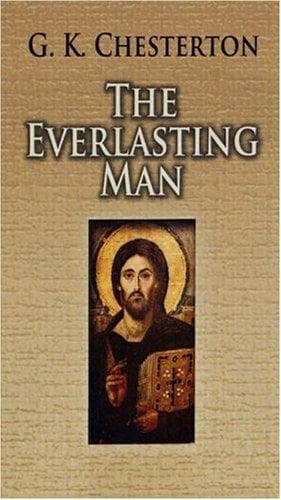
The Everlasting ManChesterton, G. K. (Gilbert Keith)
Religion
The Everlasting Man
Chesterton, G. K. (Gilbert Keith)
Catholic Church -- Apologetic works; Christianity and other religions; Religion
The tale of the end of Troy shall have no ending; for it is lifted up
for ever into living echoes, immortal as our hopelessness and our hope.
Troy standing was a small thing that may have stood nameless for ages.
But Troy falling has been caught up in a flame and suspended in an
immortal instant of annihilation; and because it was destroyed with fire
the fire shall never be destroyed. And as with the city so with the
hero; traced in archaic lines in that primeval twilight is found the
first figure of the Knight. There is a prophetic coincidence in his
title; we have spoken of the word chivalry and how it seems to mingle
the horseman with the horse. It is almost anticipated ages before in the
thunder of the Homeric hexameter, and that long leaping word with which
the Iliad ends. It is that very unity for which we can find no name but
the holy centaur of chivalry. But there are other reasons for giving in
this glimpse of antiquity the flame upon the sacred town. The sanctity
of such towns ran like a fire round the coasts and islands of the
northern Mediterranean; the high-fenced hamlet for which heroes died.
From the smallness of the city came the greatness of the citizen. Hellas
with her hundred statues produced nothing statelier than that walking
statue; the ideal of the self-commanding man. Hellas of the hundred
statues was one legend and literature; and all that labyrinth of little
walled nations resounded with the lament of Troy.
A later legend, an afterthought but not an accident, said that
stragglers from Troy founded a republic on the Italian shore. It was
true in spirit that republican virtue had such a root. A mystery of
honour, that was not born of Babylon or the Egyptian pride, there shone
like the shield of Hector, defying Asia and Africa; till the light of a
new day was loosened, with the rushing of the eagles and the coming of
the name; the name that came like a thunderclap, when the world woke to
Rome.
CHAPTER IV
GOD AND COMPARATIVE RELIGION
I was once escorted over the Roman foundations of an ancient British
city by a professor, who said something that seems to me a satire on a
good many other professors. Possibly the professor saw the joke, though
he maintained an iron gravity, and may or may not have realised that it
was a joke against a great deal of what is called comparative religion.
I pointed out a sculpture of the head of the sun with the usual halo of
rays, but with the difference that the face in the disc, instead of
being boyish like Apollo, was bearded like Neptune or Jupiter. ‘Yes,’ he
said with a certain delicate exactitude, ‘that is supposed to represent
the local god Sul. The best authorities identify Sul with Minerva; but
this has been held to show that the identification is not complete.’
Public-domain text, read in full here on John Shaqi.
Reviews
Reviews
No reviews yet
Be the first to share your thoughts on this work.
Elsewhere in the archive
Join the Discussion
Join the discussion
Sign in to leave a comment or review.
Sign InorCreate an account