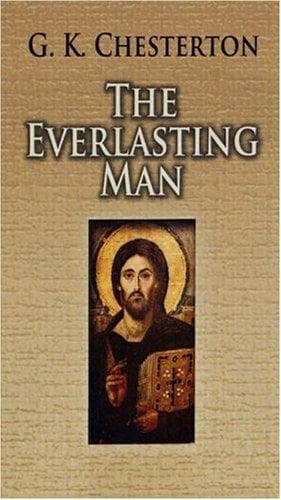
The Everlasting ManChesterton, G. K. (Gilbert Keith)
Religion
The Everlasting Man
Chesterton, G. K. (Gilbert Keith)
Catholic Church -- Apologetic works; Christianity and other religions; Religion
In truth the Church is too unique to prove herself unique. For most
popular and easy proof is by parallel; and here there is no parallel. It
is not easy, therefore, to expose the fallacy by which a false
classification is created to swamp a unique thing, when it really is a
unique thing. As there is nowhere else exactly the same fact, so there
is nowhere else exactly the same fallacy. But I will take the nearest
thing I can find to such a solitary social phenomenon, in order to show
how it is thus swamped and assimilated. I imagine most of us would agree
that there is something unusual and unique about the position of the
Jews. There is nothing that is quite in the same sense an international
nation; an ancient culture scattered in different countries but still
distinct and indestructible. Now this business is like an attempt to
make a list of nomadic nations in order to soften the strange solitude
of the Jew. It would be easy enough to do it, by the same process of
putting a plausible approximation first, and then tailing off into
totally different things thrown in somehow to make up the list. Thus in
the new list of nomadic nations the Jews would be followed by the
Gypsies; who at least are really nomadic if they are not really
national. Then the professor of the new science of Comparative Nomadics
could pass easily on to something different; even if it was very
different. He could remark on the wandering adventure of the English who
had scattered their colonies over so many seas; and call _them_ nomads.
It is quite true that a great many Englishmen seem to be strangely
restless in England. It is quite true that not all of them have left
their country for their country’s good. The moment we mention the
wandering empire of the English, we must add the strange exiled empire
of the Irish. For it is a curious fact, to be noted in our imperial
literature, that the same ubiquity and unrest which is a proof of
English enterprise and triumph is a proof of Irish futility and failure.
Then the professor of Nomadism would look round thoughtfully and
remember that there was great talk recently of German waiters, German
barbers, German clerks, Germans naturalising themselves in England and
the United States and the South American republics. The Germans would go
down as the fifth nomadic race; the words Wanderlust and Folk-Wandering
would come in very useful here. For there really have been historians
who explained the Crusades by suggesting that the Germans were found
wandering (as the police say) in what happened to be the neighbourhood
of Palestine. Then the professor, feeling he was now near the end, would
make a last leap in desperation. He would recall the fact that the
French Army has captured nearly every capital in Europe, that it marched
across countless conquered lands under Charlemagne or Napoleon; and
_that_ would be wanderlust, and _that_ would be the note of a nomadic
race. Thus he would have his six nomadic nations all compact and
Public-domain text, read in full here on John Shaqi.
Reviews
Reviews
No reviews yet
Be the first to share your thoughts on this work.
Elsewhere in the archive
Join the Discussion
Join the discussion
Sign in to leave a comment or review.
Sign InorCreate an account