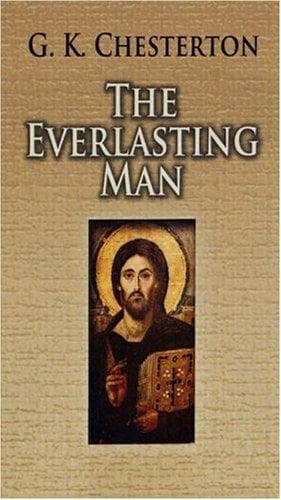
The Everlasting ManChesterton, G. K. (Gilbert Keith)
Religion
The Everlasting Man
Chesterton, G. K. (Gilbert Keith)
Catholic Church -- Apologetic works; Christianity and other religions; Religion
In other words, we have here the curiosity of religious history that the
savage seems to be parading all the most repulsive and impossible parts
of his belief and concealing all the most sensible and creditable parts.
But the explanation is that they are not in that sense parts of his
belief; or at least not parts of the same sort of belief. The myths are
merely tall stories, though as tall as the sky, the waterspout, or the
tropic rain. The mysteries are true stories, and are taken secretly that
they may be taken seriously. Indeed it is only too easy to forget that
there is a thrill in theism. A novel in which a number of separate
characters all turned out to be the same character would certainly be a
sensational novel. It is so with the idea that sun and tree and river
are the disguises of one god and not of many. Alas, we also find it only
too easy to take Atahocan for granted. But whether he is allowed to fade
into a truism or preserved as a sensation by being preserved as a
secret, it is clear that he is always either an old truism or an old
tradition. There is nothing to show that he is an improved product of
the mere mythology and everything to show that he preceded it. He is
worshipped by the simplest tribes with no trace of ghosts or
grave-offerings, or any of the complications in which Herbert Spencer
and Grant Allen sought the origin of the simplest of all ideas. Whatever
else there was, there was never any such thing as the Evolution of the
Idea of God. The idea was concealed, was avoided, was almost forgotten,
was even explained away; but it was never evolved. There are not a few
indications of this change in other places. It is implied, for
instance, in the fact that even polytheism seems often the combination
of several monotheisms. A god will gain only a minor seat on Mount
Olympus, when he had owned earth and heaven and all the stars while he
lived in his own little valley. Like many a small nation melting in a
great empire, he gives up local universality only to come under
universal limitation. The very name of Pan suggests that he became a god
of the wood when he had been a god of the world. The very name of
Jupiter is almost a pagan translation of the words ‘Our Father which art
in heaven.’ As with the Great Father symbolised by the sky, so with the
Great Mother whom we still call Mother Earth. Demeter and Ceres and
Cybele often seem to be almost incapable of taking over the whole
business of godhood, so that men should need no other gods. It seems
reasonably probable that a good many men did have no other gods but one
of these, worshipped as the author of all.
Public-domain text, read in full here on John Shaqi.
Reviews
Reviews
No reviews yet
Be the first to share your thoughts on this work.
Elsewhere in the archive
Join the Discussion
Join the discussion
Sign in to leave a comment or review.
Sign InorCreate an account