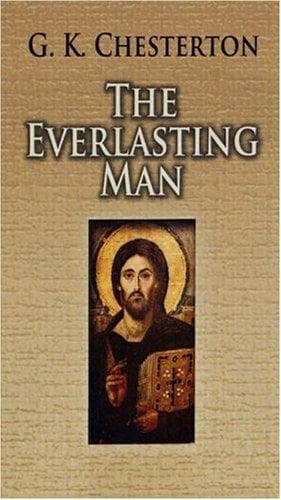
The Everlasting ManChesterton, G. K. (Gilbert Keith)
Religion
The Everlasting Man
Chesterton, G. K. (Gilbert Keith)
Catholic Church -- Apologetic works; Christianity and other religions; Religion
Over some of the most immense and populous tracts of the world, such as
China, it would seem that the simpler idea of the Great Father has never
been very much complicated with rival cults, though it may have in some
sense ceased to be a cult itself. The best authorities seem to think
that though Confucianism is in one sense agnosticism, it does not
directly contradict the old theism, precisely because it has become a
rather vague theism. It is one in which God is called Heaven, as in the
case of polite persons tempted to swear in drawing-rooms. But Heaven is
still overhead, even if it is very far overhead. We have all the
impression of a simple truth that has receded, until it was remote
without ceasing to be true. And this phrase alone would bring us back to
the same idea even in the pagan mythology of the West. There is surely
something of this very notion of the withdrawal of some higher power in
all those mysterious and very imaginative myths about the separation of
earth and sky. In a hundred forms we are told that heaven and earth were
once lovers, or were once at one, when some upstart thing, often some
undutiful child, thrust them apart; and the world was built on an abyss;
upon a division and a parting. One of its grossest versions was given by
Greek civilisation in the myth of Uranus and Saturn. One of its most
charming versions was that of some savage people, who say that a little
pepper-plant grew taller and taller and lifted the whole sky like a lid;
a beautiful barbaric vision of daybreak for some of our painters who
love that tropical twilight. Of myths, and the highly mythical
explanations which the moderns offer of myths, something will be said in
another section; for I cannot but think that most mythology is on
another and more superficial plane. But in this primeval vision of the
rending of one world into two there is surely something more of ultimate
ideas. As to what it means, a man will learn far more about it by lying
on his back in a field, and merely looking at the sky, than by reading
all the libraries even of the most learned and valuable folk-lore. He
will know what is meant by saying that the sky ought to be nearer to us
than it is, that perhaps it was once nearer than it is, that it is not a
thing merely alien and abysmal but in some fashion sundered from us and
saying farewell. There will creep across his mind the curious suggestion
that after all, perhaps, the myth-maker was not merely a moon-calf or
village idiot thinking he could cut up the clouds like a cake, but had
in him something more than it is fashionable to attribute to the
Troglodyte; that it is just possible that Thomas Hood was not talking
like a Troglodyte when he said that, as time went on, the tree-tops only
told him he was further off from heaven than when he was a boy. But
anyhow the legend of Uranus the Lord of Heaven dethroned by Saturn the
Time Spirit would mean something to the author of that poem. And it
Public-domain text, read in full here on John Shaqi.
Reviews
Reviews
No reviews yet
Be the first to share your thoughts on this work.
Elsewhere in the archive
Join the Discussion
Join the discussion
Sign in to leave a comment or review.
Sign InorCreate an account