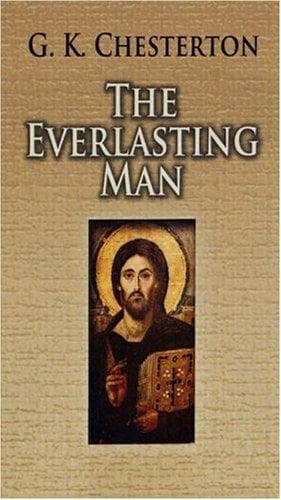
The Everlasting ManChesterton, G. K. (Gilbert Keith)
Religion
The Everlasting Man
Chesterton, G. K. (Gilbert Keith)
Catholic Church -- Apologetic works; Christianity and other religions; Religion
The unique possession was not available or accessible to the pagan
world, because it was also the possession of a jealous people. The Jews
were unpopular, partly because of this narrowness already noted in the
Roman world, partly perhaps because they had already fallen into that
habit of merely handling things for exchange instead of working to make
them with their hands. It was partly also because polytheism had become
a sort of jungle in which solitary monotheism could be lost; but it is
strange to realise how completely it really was lost. Apart from more
disputed matters, there were things in the tradition of Israel which
belong to all humanity now, and might have belonged to all humanity
then. They had one of the colossal corner-stones of the world: the Book
of Job. It obviously stands over against the Iliad and the Greek
tragedies; and even more than they it was an early meeting and parting
of poetry and philosophy in the morning of the world. It is a solemn and
uplifting sight to see those two eternal fools, the optimist and the
pessimist, destroyed in the dawn of time. And the philosophy really
perfects the pagan tragic irony, precisely because it is more
monotheistic and therefore more mystical. Indeed the Book of Job
avowedly only answers mystery with mystery. Job is comforted with
riddles; but he is comforted. Herein is indeed a type, in the sense of
a prophecy, of things speaking with authority. For when he who doubts
can only say, ‘I do not understand,’ it is true that he who knows can
only reply or repeat, ‘You do not understand.’ And under that rebuke
there is always a sudden hope in the heart; and the sense of something
that would be worth understanding. But this mighty monotheistic poem
remained unremarked by the whole world of antiquity, which was thronged
with polytheistic poetry. It is a sign of the way in which the Jews
stood apart and kept their tradition unshaken and unshared, that they
should have kept a thing like the Book of Job out of the whole
intellectual world of antiquity. It is as if the Egyptians had modestly
concealed the Great Pyramid. But there were other reasons for a
cross-purpose and an impasse, characteristic of the whole of the end of
paganism. After all, the tradition of Israel had only got hold of one
half of the truth, even if we use the popular paradox and call it the
bigger half. I shall try to sketch in the next chapter that love of
locality and of personality that ran through mythology; here it need
only be said that there was a truth in it that could not be left out,
though it were a lighter and less essential truth. The sorrow of Job had
to be joined with the sorrow of Hector; and while the former was the
sorrow of the universe the latter was the sorrow of the city; for Hector
could only stand pointing to heaven as the pillar of holy Troy. When God
speaks out of the whirlwind He may well speak in the wilderness. But the
monotheism of the nomad was not enough for all that varied civilisation
Public-domain text, read in full here on John Shaqi.
Reviews
Reviews
No reviews yet
Be the first to share your thoughts on this work.
Elsewhere in the archive
Join the Discussion
Join the discussion
Sign in to leave a comment or review.
Sign InorCreate an account