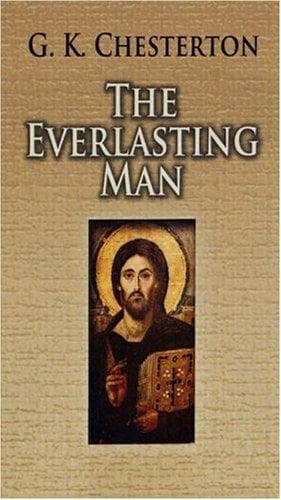
The Everlasting ManChesterton, G. K. (Gilbert Keith)
Religion
The Everlasting Man
Chesterton, G. K. (Gilbert Keith)
Catholic Church -- Apologetic works; Christianity and other religions; Religion
Astarte, feasting in fellowship with the gods; the last god to sell his
crown of stars for the Soma of the Indian pantheon or the nectar of
Olympus or the mead of Valhalla. It would have been easy enough for his
worshippers to follow the enlightened course of Syncretism and the
pooling of all the pagan traditions. It is obvious indeed that his
followers were always sliding down this easy slope; and it required the
almost demoniac energy of certain inspired demagogues, who testified to
the divine unity in words that are still like winds of inspiration and
ruin. The more we really understand of the ancient conditions that
contributed to the final culture of the Faith, the more we shall have a
real and even a realistic reverence for the greatness of the Prophets of
Israel. As it was, while the whole world melted into this mass of
confused mythology, this Deity who is called tribal and narrow,
precisely because he was what is called tribal and narrow, preserved the
primary religion of all mankind. He was tribal enough to be universal.
He was as narrow as the universe.
In a word, there was a popular pagan god called Jupiter-Ammon. There was
never a god called Jehovah-Ammon. There was never a god called
Jehovah-Jupiter. If there had been, there would certainly have been
another called Jehovah-Moloch. Long before the liberal and enlightened
amalgamators had got so far afield as Jupiter, the image of the Lord of
Hosts would have been deformed out of all suggestion of a monotheistic
maker and ruler and would have become an idol far worse than any savage
fetish; for he might have been as civilised as the gods of Tyre and
Carthage. What that civilisation meant we shall consider more fully in
the chapter that follows; when we note how the power of demons nearly
destroyed Europe and even the heathen health of the world. But the
world’s destiny would have been distorted still more fatally if
monotheism had failed in the Mosaic tradition. I hope in a subsequent
section to show that I am not without sympathy with all that health in
the heathen world that made its fairy-tales and its fanciful romances
of religion. But I hope also to show that these were bound to fail in
the long run; and the world would have been lost if it had been unable
to return to that great original simplicity of a single authority in all
things. That we do preserve something of that primary simplicity, that
poets and philosophers can still indeed in some sense say an Universal
Prayer, that we live in a large and serene world under a sky that
stretches paternally over all the peoples of the earth, that philosophy
and philanthropy are truisms in a religion of reasonable men, all that
we do most truly owe, under heaven, to a secretive and restless nomadic
people; who bestowed on men the supreme and serene blessing of a jealous
God.
Public-domain text, read in full here on John Shaqi.
Reviews
Reviews
No reviews yet
Be the first to share your thoughts on this work.
Elsewhere in the archive
Join the Discussion
Join the discussion
Sign in to leave a comment or review.
Sign InorCreate an account